
Three years ago my wife decided like any logical person would, to put down the rifle and take up handgun hunting. She wanted me to teach her to shoot a revolver accurately in the field. When we first started I just completely skipped over the basics and started 2-3 steps ahead and luckily I caught myself and came back down to earth and started with the basics.
The basics focus on the grip and stance of the shooter. This foundation of knowledge and skill is then applied to all other field shooting positions.
Shooting a handgun to the accuracy level we strive for in the field is a little different than action shooting such as defensive or race/speed shooting. As a handgun hunter we are striving for precision similar to a bullseye competition shooter where we want to place all the rounds in the X ring.
With all gun safety in mind we want to first focus on the grip. The grip is something I like to teach away from the range. No ammo should be included in learning the grip, in fact we don’t even need to press the trigger yet.
With an unloaded firearm in a safe environment we want to work through “building our grip”. With time and repetition this will become second nature, but for now we need to think through it.
First thing we need to do is locate where the back strap of the revolver is going to contact. We want the back strap to be centered on the soft web of the hand. This will allow the gun to recoil smoothly as well as the fingers to wrap around the grip and fall in the right position.

We also want to avoid as much contact as possible with the bottom most thumb joint. Impact here from the large handguns we often use when hunting will lead to a great deal of pain.

In the process of finding the appropriate placement of the back strap in the web of the hand we want to make sure our primary hands knuckles are centered on the front of the grip.

Once the primary/strong hand is on the grip the knuckles of the primary hand “punch” into the back of the off hands knuckles.

Now we want to fold the thumbs down along the side and make sure they do not impact the recoil shield, cylinder release, or extend past the front of the cylinder.

So far the grip is exactly the same as an action shooter but we are about to start changing things up!
We want about 70% of our grip pressure with the strong hand and 30% with the off hand. We push forward with our strong arm and pull back with our off hand/arm. We do not want a death grip on the gun. We literally just want to hold it tight enough so it doesn’t fly out under recoil. What happens after the trigger is pulled is just as important as what happens before the trigger is pulled. This is called follow through. It’s much easier to be precise with our follow through with a relaxed hold on the gun than a tight hold. We will come back to this later.
Since we are going for maximum precision we will most likely be shooting our handgun in single action (hammer cocked). We will want to place just the first pad of our index finger on the trigger.

Now we have established our grip and trigger finger placement. Handgun shooting to me starts with the basic standing position and we build all of our other field shooting positions from there.
To establish our basic standing position I want you to think about how you would be stalking or closing the distance on game. We would be walking upright and as we came upon the animal we would most likely be mid stride, meaning one foot forward and one foot farther back. I don’t personally think it matters which foot is forward or back as it’s possible we could end up either way in the field. So now we want to take that stance with one foot forward within a normal strides length and one foot slightly back.

Keep your shoulders and hips in line and facing the target.
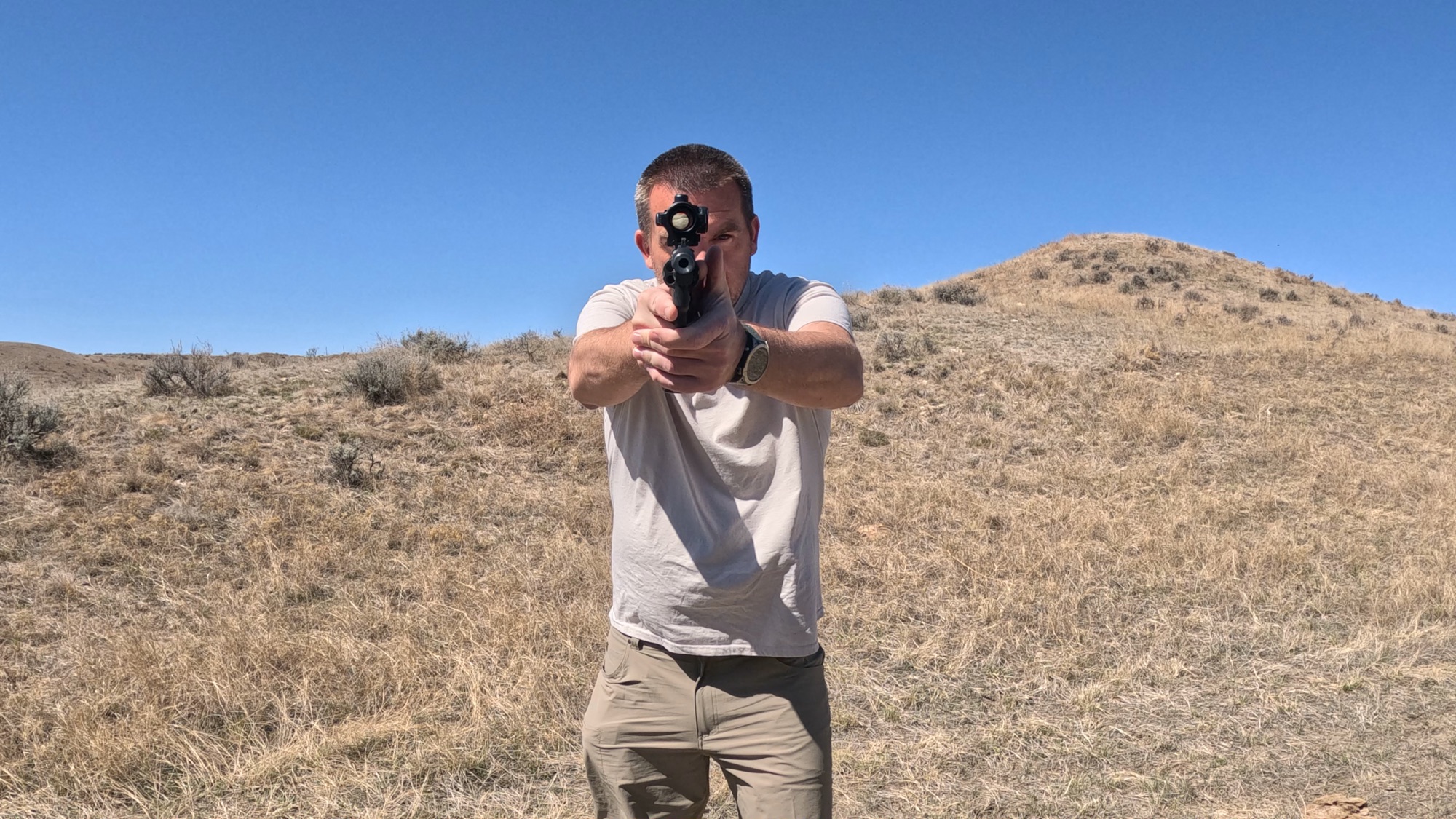
Now with an unloaded firearm in a safe setting form your grip as we went over earlier. Extend your arms to about 95% of full extension. We want a slight bend in the elbows to help with recoil absorption.

We also want just a slight forward lean to our stance. As you can see in the above photo I’m barely leaning forward. We want our body to move with the recoil of the larger cartridges. Fighting the recoil will just degrade our accuracy, we want absolute precision.

Now to put it all together. We want to grasp our firearm firmly but not squeezing it overly tight. We want the gun to move almost freely with each shot. The recoil energy will be absorbed by the web of the hand, the bent elbows, and then the body. Our grip pressure must stay the same until the gun finishes recoiling or we will negatively impact accuracy. Our hips and shoulders need to be square to and facing the target or we will pull shots left or right.
The grip and stance should now be practiced with dry fire. No ammunition should be around you or in the area during dry fire. You need to visually and physically inspect the firearm to make sure it is unloaded. Using a small target at 10 or so feet inside your home with an unloaded gun will work well. I like to lay the gun on a table in front of me, take a perfect stance, form a perfect grip, dry fire once, then lay the gun back down and start the process over. Repeating this process for 15-20 reps at a time will form a “grip/stance memory” which will be very important as you move forward in your practice and eventually the field.
It took my wife three hunting seasons before she took her first shot on a big game animal with a revolver. Over that time she competed in Handgun Hunter’s Competition twice and her confidence had grown. When it finally came time to take the shot it worked out like clockwork.

What I have found to be the secret to success is perfect practice. Keep it short, keep it focused, and keep it precise. With that being said you have to train to your failure point and push your limits. Keep trying farther and/or smaller targets. Do not forget dry fire! I know it’s boring but it’s important!
Field shooting accuracy will take time. Practice your dry fire and live fire as much as possible and you will be successful.
I plan to continue these basics articles. If there are topics you would like covered comment bellow or email me at handgunhuntingafield@gmail.com
One response to “Back to basics by: Chris Rhodes”
[…] Back to basics […]