
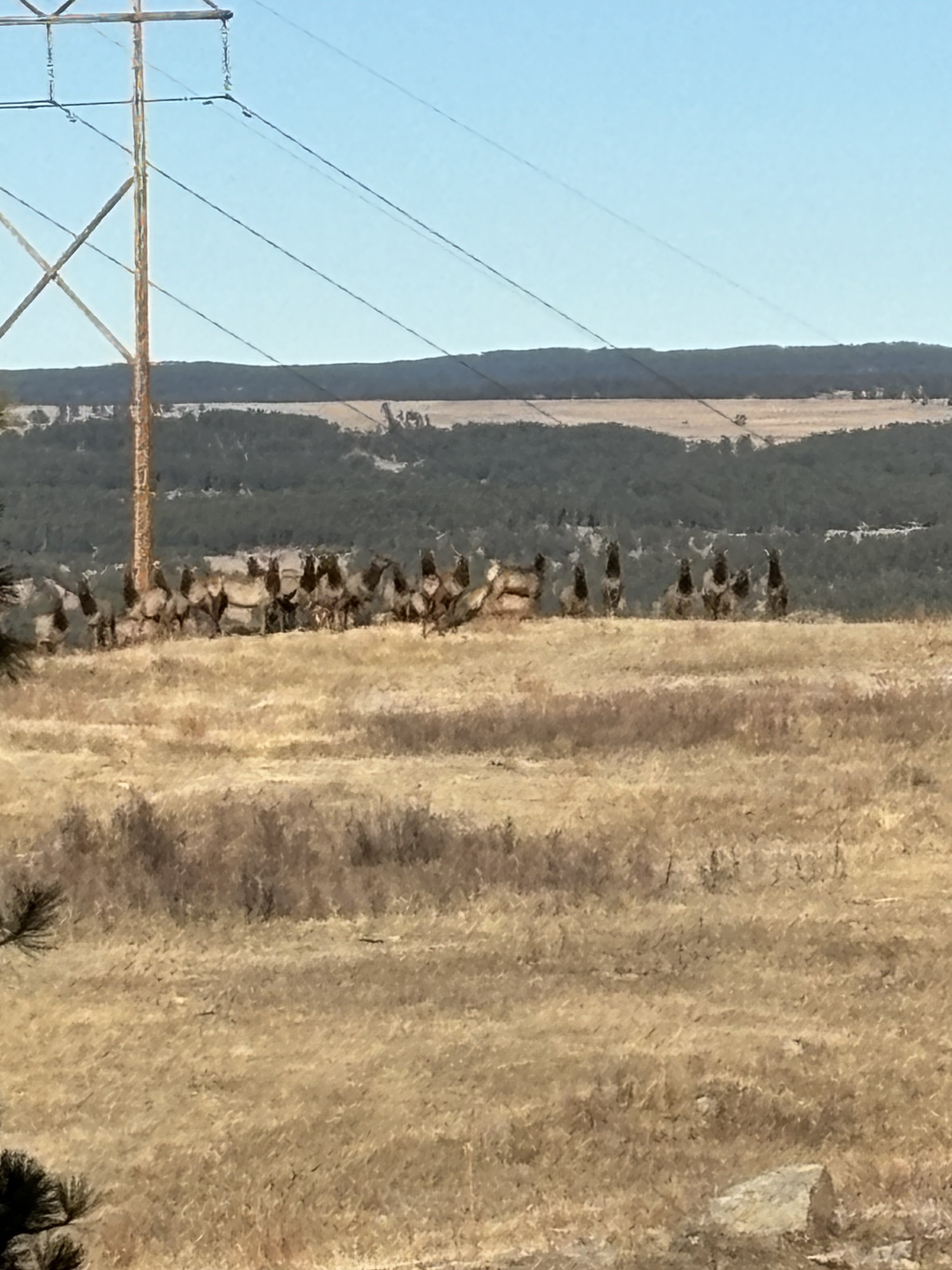
Late season cow elk hunting is a staple of my Wyoming hunting each year. In the late season the elk tend to group up into large herds; many times these herds will number from 100-200 head. That makes for a lot of eyeballs to evade on a stalk!

Just prior to Thanksgiving I struck out in search of a cow elk on the eastern side of Wyoming. I arrived at my parking spot prior to dawn and began an uphill trek into the area I planned to hunt. It was well below freezing with a 18+ mile per hour wind that was building. As I walked up the hill I was immediately alerted by an odor you will never forget, ELK! While still in the dark I bumped a young bull. Not to be discouraged I continued to press on and shortly after day break I spotted antlers moving through the trees. The wind had now built up in excess of 20 miles per hour which not only cleared my odor out of the area but also concealed my movement and any noise I may have inadvertently made. I continued to watch the bull through the trees where I could only see the top of his antlers and I was unsure if he was alone or with a group of elk. So I decided to set up and try to call them in. The only spot I had that would allow me to shoot was wide out in the open. I drew my 460 S&W and turned on my Ultradot Gen2.

I then began to cow call and almost immediately I noticed the antlers make a sharp turn towards me; he was coming my way! I continued to call and change up my tone while staying as motionless as possible. Out of nowhere a buck mule deer fed 20 yards to my right towards the elk and never looked at me as he fed between myself and the elk. I continued to call and before I knew it I had a group of elk to my front under 40 yards but sadly they were all bulls. I stopped calling and eventually they moved on never identifying me.
I continued to work farther back into the area with the wind in my favor. I looked over one ridge and spotted another herd of bulls 600 yards away in a valley. I glassed them for a bit to confirm that no cow elk were with them and then I continued to press on.
I looked down at my Garmin watch and noticed that it was now reading 28 mile per hour winds; no wonder my face hurt from the cold. I then peered over one last ridge and the excitement started to build. A herd of 200 or more elk were just over 500 yards away but there was a catch; between them and I there was zero cover. I glassed the elk for several minutes and noticed most were feeding away from me. There was one stalk option that I could find while glassing but it was going to leave me wide out in the open for five or more minutes until I could drop down into a ditch.

I continued to glass the elk and look for an opening to make a move. Eventually half the herd was working into some distant pine trees while the rest followed feeding with their heads down; it was now or never.
I quickly rushed down the hill towards the ditch. Walking quickly and even jogging on some of the more level ground. Once I got into the ditch I had a direct path I could move in that gave me decent concealment until I would be on the elk. I drew my 460 S&W and turned on the Ultradot Gen 2 again and proceeded to move in the direction of where the elk were last seen. As I began to climb out of the ditch and approached a small knob they were last seen behind I collected myself, slowed my breathing, and took a good shooting grip on the gun. I began to “slice the pie” around the edge of the knob very slowly. After a little over 3 minutes working around the knob I could clearly see behind it and the elk had moved on. I know it was unlikely that I spooked them and guessed they followed the others into the pines. I kept the 460 S&W at the ready and worked into the trees. In short order I spotted the herd in an opening. I was in a tangled mess of downed trees and tightly packed new growth. I took my pack off and began looking for an opening; the elk were under 50 yards away and I had 200 or more sets of eyes to avoid.
I eventually found a softball sized opening in the trees to place a shot and the herd was moving in that direction. I was set up between a kneeling and a squatting position but felt plenty stable for the distance. A cow elk finally stepped into my small shooting window which had a large down tree at the bottom of it and a tangled mess of live trees above it. I centered the dot on the cow elk’s vitals and touched off a 240 grain Cutting Edge Handgun Raptor. Right after the BANG I saw white material flying through the air! “What the heck was that” I said out loud. As I scanned to my front I realized I center punched the log just below my shot window.
When elk are in large groups like this they often delay their reaction. It’s almost like they are trying to decide who is in charge. I observed the herd and it was obvious no elk were hit. They trotted off to my left a couple hundred yards and I could hear them slow down.
Counting on the elk to be slow to react I went into aggressive hunting mode. I took off after them to the next high spot. Sure enough they were all milling around the bottom trying to figure out what to do.
I quickly ranged a group of cow elk at 274 yards. There was no time to get closer so out came the TC contender in 375 JDJ; it was time to make some sausage! I put my pack down and took up a prone position looking steep downhill at the elk. I rested the TC on the pack and waited for a cow to step clear. The cow I was focused on continued to rotate around and I could tell they were getting ready to bolt. The cow faced me and I held the BDC reticle of the Burris 2-7 handgun scope on the 2nd hold over line for my drop at 274 yards just in front of her left shoulder. I cocked the hammer and applied pressure to the trigger sending a 200 grain Cutting Edge Bullets Handgun Raptor on its way. An instant reaction was seen on the elk and an audible “smack” was heard when the bullet impacted. Now it was time for some hard work!


The cow was shot on a steep hillside in the deadfall and I was hunting solo. This was going to be a tough skinning and packing job! I began calling around for assistance and couldn’t find any due to it being mid week, so down the hill I went to get to work.

I had to move the cow around multiple times to skin and quarter in the deadfall which is no easy task. Cow elk are generally in the 300 to 400 pound range which caused a good bit of grunting and straining to move it around.


During the quartering I discovered that the bullet entered the chest where the shot was placed and continued all the way through the elk with the base of the Handgun Raptor breaking the back hip and exiting. That’s some exceptional penetration from a bullet which I credit to the fracturing design. After the bullet expands and causes massive trauma it sheds its petals thus reducing drag and allowing it to continue to penetrate.
I then proceeded to pack one hind quarter up the hill to where I had cell service. Once at the top of the hill I checked my phone and no one wanted to help pack out! I then gave my wife a call and she drove out to meet me where I parked at and helped me pack out.
We took the Pack-Wheel back to the edge of the hillside where I shot the elk and left it there. We both went down the hill and got the rest of the elk to the top in one trip. We were able to load both hind quarters onto the Pack-Wheel and each of us carried a shoulder. Getting an elk out in one trip sure is a time and energy saver.


Every hunt is not going to go perfect. You are going to miss shots, blow stalks, and so on. Thats hunting. It’s how you recover from it after the failure that’s important. Never give up!
All of my Cutting Edge Bullets Load Data can be found here:
Cutting Edge Bullets Load Data (Updated 7-26-24) by: Chris Rhodes
One response to “Late Season Elk, Wyoming by: Chris Rhodes”
Great story and told as it should be. Huge congrats on the elk.