
Ultradot optics have a long-standing, well-deserved, reputation for ruggedness, accuracy, and optical quality. Their latest offering, the Matchdot II, combines all these characteristics with new features which add versatility and function giving target shooters and hunters alike an optic which excels in its class.
Ultradot supplied two samples of the new Matchdot II, a traditional red dot and their new green dot, for testing. Outside the different reticle colors, the two optics are identical in function. The most striking new feature of the Matchdot II is the exposed elevation turret located aft of the brightness control on the top of the optic. I did note when dialing the elevation turrets that I would prefer if the optics had more audible and tactile clicks, this would aid when making adjustments while wearing hearing protection or gloves. Upon further inspection, the brightness control also features some changes. Like the original Matchdot, there are 11 brightness settings available. However, between each setting on the Matchdot II there is now an off position. This enables users to keep their preferred brightness setting just a click away. A third new feature is the addition of two easily selectable reticle options along with 2, 4, and 6 MOA dots. The first reticle is a circle dot style reticle featuring a 55 MOA outer ring and an 8 MOA center dot. The second is combination circle dot adding cross hairs measuring 80 MOA flanking a circle measuring 30 MOA and a center 2 MOA dot (https://ultradotusa.com/product/matchdot-ii-m/). All these options are easily selectable by rotating the knob on the left side of the optic.

I spent several days with these optics set side by side on a tripod staring through them in all sorts of lighting conditions trying to assess differences in the reticles or clarity of the optic. I have discovered I prefer the red dot version of this optic in all the lighting conditions I compared them in, but this is certainly a matter of shooter preference. For me, the green dot is especially visible in very low light, but it turns into a large oblong starburst, even with the brightness at the lowest setting. This is not the fault of the optic but rather a result of my astigmatism and lasik surgery. The lenses on the green version of this sample of Matchdot II also appeared purplish to my eye. This tint had no impact on clarity or brightness of the glass as they were excellent in both versions, allowing shots to be made in the lowlight shooting conditions many hunters experience.

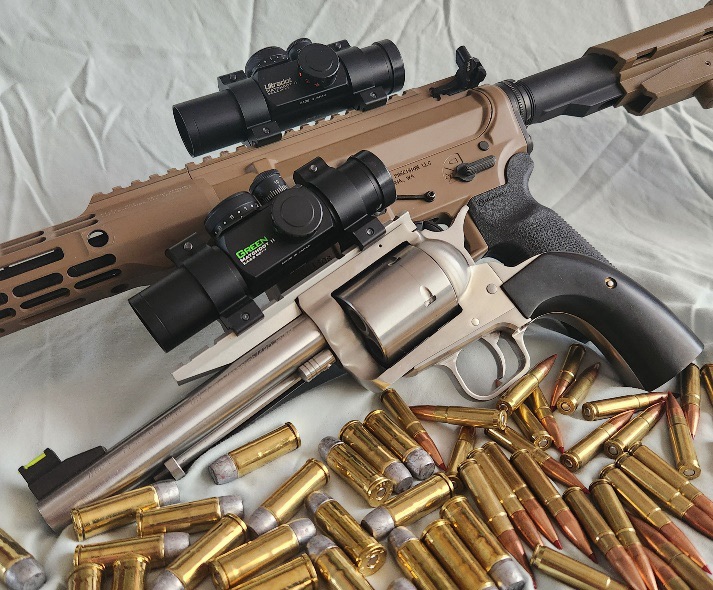
The first question I often hear when people are looking for handgun optics is something along the lines of “Will this hold up to my hand cannon of choice?” With this in mind, I began my review by mounting the green dot atop a Magnum Research BFR chambered in 475 Linebaugh. Recoil is certainly sporty with John Linebaugh’s creation, so I opted to start with some top end loads of 480 Ruger for sight in and warm up. Once mounted, I did note that the vertical split rings included with all Ultradot optics do interfere with the shooters ability to see the elevation turret when behind the gun. Switching to a lower profile, horizontally split ring, may alleviate this issue.
My first shots went wide of the mark but after a few simple adjustments of the one MOA per click dials I was firing the 375 grain slugs easily into a sub-Minute of Deer Heart (MDH) group at 50 yards. Four or five cylinders full later, I decided it was time to step up the intensity. I fired a few rounds of 475 to adjust for the shift in zero before stoking the BFR with full house 475 LB. I decided to stand to better manage the recoil and proceeded to hammer my AR500 targets at 50 yards. After a few more cylinders, I decided I was sufficiently pummeled to prove the point. This optic, and many others by Ultradot, shrug of the heaviest recoil you can throw at them without a hitch.


Getting the heavy hitting out of the way, I opted to test the accuracy of the newly added elevation turret. I enjoy tinkering with subsonic loads in 300 AAC Blackout and using them on game requires thorough knowledge of their rainbow-like trajectory when engaging game much beyond 75 yards or even while trying to hit very small targets at closer ranges. I mounted the red dot version of the Matchdot II on my suppressed AR platform and began sight-in at 50 yards. In this application the provided rings seated the optic quite low, which made it easy to achieve proper cheek weld even with a stock installed which is not noted for its ability to provide ample cheek support when using cantilever mounted optics.
I paired a one-inch circle target with the 2 MOA dot for my 50-yard sight-in. All windage and elevation adjustments seemed to track precisely, and I quickly zeroed the gun. I then backed out to 100 yards and with a couple small adjustments I was again zeroed. Again, the design of the supplied rings did block the view of the elevation turret completely from the firing position in this application and users may want to try lower profile, horizontally split, rings. Once zeroed, I followed the simple instructions provided to reset the turret to zero while maintaining my point of impact.
After several days of waiting out inclement weather I got back to testing. I again chose the 2 MOA dot and paired it with a two-inch circle target at 100 yards. I dialed the elevation down three clicks and sent my first three rounds. I repeated the steps for my second group, before dialing all the way back to zero for my third, three-round group. After retrieving my target, I was surprised to see that all the groups fell slightly low and left of where I expected them to, however, the center of all the groups were spaced almost exactly three inches apart precisely as they should be at this range given the adjustments I made. I believe that my initial hundred yard zero was also low and left and the dope behind the scope likely misread the clutter on the initial target.

In closing, the new Matchdot II appears to be on par with the function and quality many users have come to expect from Ultradot optics over the years. The addition of a variety of easily selectable dots and reticles along with user friendly brightness selections are a welcome addition. Though I believe the elevation turret could use a little refinement to aid in field use, it was perfectly functional and dialed accurately. If you’re looking for a rugged optic that is ready for field use in a wide variety of situations the Matchdot II is certainly worth a look.
One response to “Ultradot and a Hand Cannon by: Jake Kitzmann”
Nice write up Jake, thanks for sharing your experience.