
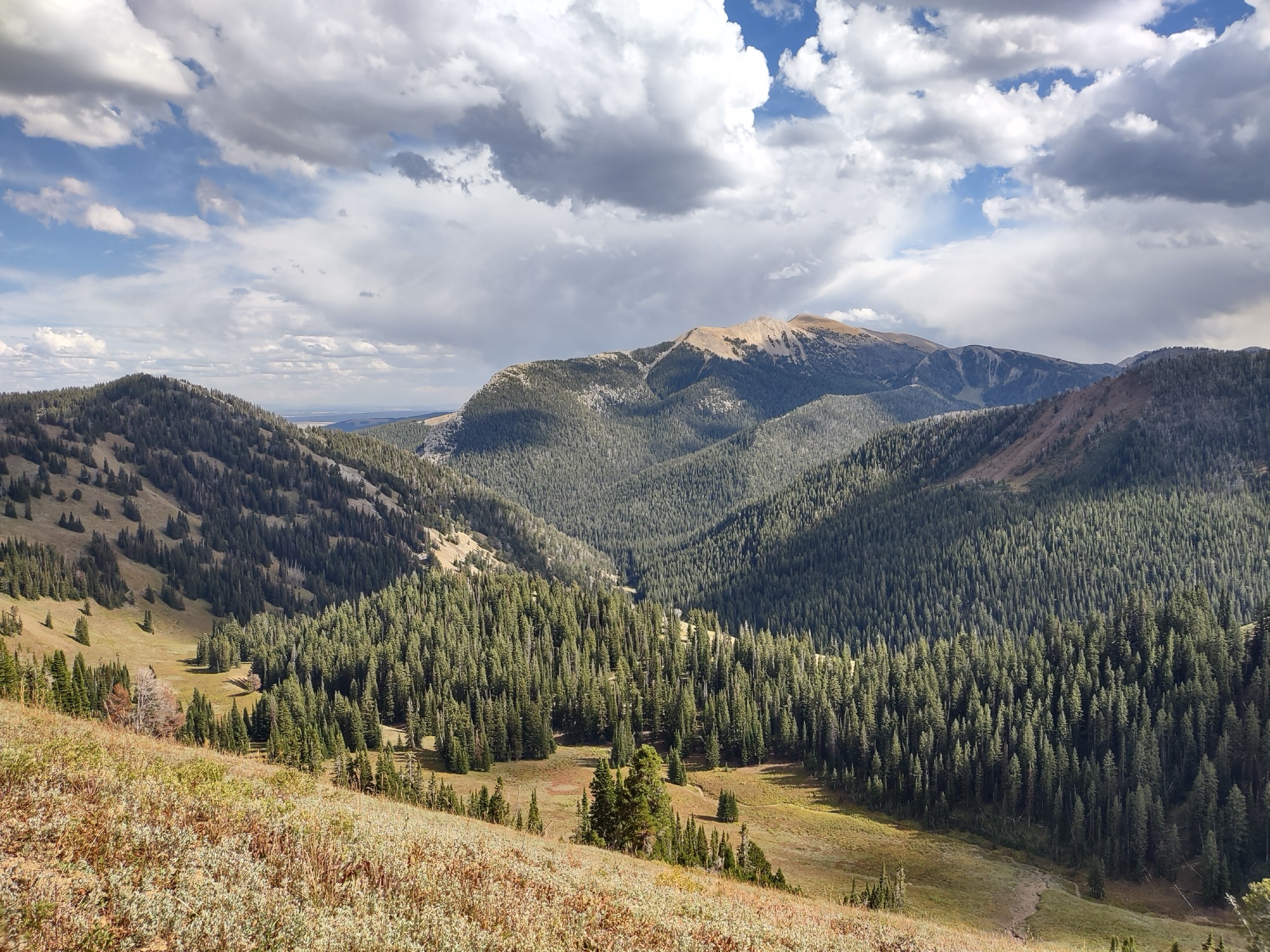
Backcountry hunting: the pursuit of wild game in pristine wilderness, where rugged terrain and challenging hunts lead to hard-earned success. It’s a dream I’ve held for years, and after moving to Wyoming, I finally had the opportunity to make it a reality. But as I quickly discovered, backcountry hunting demands more than just passion; it requires preparation, the right gear, and a level of physical and mental fortitude I hadn’t fully anticipated. I wanted to share lessons I have learned about this.
My early backcountry experiences were a mix of excitement and humbling lessons. While I grew up hiking and camping with my late father, decades had passed since I ventured again deep into the wilderness. Backpacking, with its complex gear and multi-day challenges, was a skill I had to relearn. Adding hunting to the mix elevated the complexity to a whole new level.

My first major backcountry adventure was an attempt to summit Cloud Peak, the highest point in the Bighorn Mountains. Conditions were perfect, but the wilderness had a surprise for me. That day, it was unusually warm, and the rapidly melting snow made it unsafe to hike the last two miles. This trip, along with numerous others during the 2022 hunting season, served as a crash course in backcountry preparedness. Hunting seasons in 2023 and 2024 were continuation of the backcountry academy. I learned the importance of precise gear selection and rigorous testing. A pre-trip inspection is crucial and usually catches obvious problems, but true comfort and functionality can only be assessed in the field. Shorter trips during the summer, when the weather is generally safer, are the best way to test gear.

There are no two trips that are ever the same. Even returning to a familiar location, factors like sleep, diet, and weather can dramatically alter the experience. Carrying 100 pounds on your back in two inches of snow is vastly different than carrying the same weight in six inches or more. The deeper snow makes for more difficult footing, requiring significantly more effort and increasing the risk of slipping. The added challenge can feel exponential, not just incremental.
The backcountry is unforgiving. There are no safety nets except those we create ourselves. Preparation is paramount. Damaged or improper gear, or inadequate physical fitness, can have dire consequences. A sudden rainstorm five or ten miles deep in the wilderness is far more serious than one on your doorstep. In the wilderness, one has to know how to deal with such situations in order to survive.
Physical Fitness is Key! Lightweight gear means little if I amcarrying excess body weight or lack the stamina to cover challenging terrain. Backcountry hunts can easily burn upwards of 5,000 calories per day, demanding year-round physical conditioning. Endurance, strength, and cardiovascular fitness are essential, not just for the hunt itself, but also for safely packing out a harvested animal. Last season, on some challenging hunts and hikes, there was no question I would make it back; I was just slower than usual. There is nothing easy about backcountry hunting, even less about backcountry elk hunting. Elk hunting often involves steep terrain, long distances, and heavy packs, pushing both physical and mental limits. I am planning to get back to marathon running, not just running 3-4 miles three times per week, to be in better shape for the next fall season.

Proper footwear is crucial. Blisters or/and any feet discomfort can quickly derail a backcountry adventure. Boots should provide both comfort and support, especially when carrying heavy loads. This is one piece of gear where I will not save money. Good boots can mean the difference between a sprained or broken ankle and no injury, which, deep in the backcountry, can mean the difference between making it back and becoming a statistic. I look for waterproof boots with a good ankle support. They should not be broken in in traditional sense, soft and flexible boots will not provide needed ankle and foot support.They should just fit well.
Layering clothing is equally important. Backcountry hunting involves periods of intense activity followed by hours of stillness, requiring adaptability to fluctuating temperatures. It is needed to wear a base layer that keeps moisture away from my skin, an insulating mid-layer (thicker in winter, thinner in fall), and a waterproof/windproof outer shell. And I never forget hats and gloves – multiple pairs in varying thicknesses are recommended.

The “Big Three” of Sleeping Gear:
• Sleeping Bag: I choose a bag appropriate for the worst expected temperatures. Down bags offer excellent warmth-to-weight ratios, making them ideal for colder conditions, but they lose their insulating properties when wet. Synthetic bags are more resistant to moisture, making them a better choice in damp environments, but they tend to be heavier. I use down filled 0 degree sleeping quilt. Even during August, temperatures in backcountry can drop below freezing. If it is too hot, I just use it unzip as a quilt cover.
• Sleeping Pad: This provides crucial insulation and cushioning. A warm sleeping bag is useless if compressed against the cold ground.
• Shelter: Tents, bivy sacks, or hammocks offer protection from the elements. I prefer freestanding tents because of their versatility in varying terrain, even though they tend to be a little heavier than non-freestanding tents. In case of going deeper in backcountry, then I will use my non-freestanding tents.
A quality hunting backpack is more than just a bag that holds all gear; it’s the backbone of a successful and comfortable hunt, especially in the backcountry. Proper weight distribution is crucial, something I relearned the hard way during my last hunt, which made the pack out very challenging. For some reason I ignored some already learned lessons. Heavy loads, particularly meat, hide, head of the animal after a successful harvest, should be positioned as close to the body’s center of gravity as possible. This minimizes strain, improves balance, and allows for more efficient movement over challenging terrain. A well-designed pack with a robust frame and adjustable harness system will transfer most of the weight to your legs and it allows for this crucial weight management, preventing fatigue and potential injury, ultimately ensuring a safer and more enjoyable hunting experience.
Beyond the “Big Three” my pack always includes a water filter, water bottle, first-aid kit, cooking essentials (like a lightweight stove, cookware, and utensils), extra socks, fire-starting tools (matches or a lighter in a waterproof container), map of the area and compass, game bags, a good knife, latex gloves, paracord (a strong, versatile cord useful for many tasks), a bag for tags and licenses and of course food. The first-aid kit needs to be easily accessible. Food is mostly dry, carbs rich because it offers the best weight to calory value ratio. Bear proof bag or container is needed as well, to store food (and other attractants like toothpaste etc) during night, downwind from camp.

My backcountry hunting firearm setup prioritizes both close-range capability and preparedness. I carry a revolver in a custom chest holster and harness as my primary hunting and defense tool. Holster and harness I use are made by Nixon Leather. For longer shots, where closing the distance is not feasible, a single-shot pistol is readily accessible, strapped to the side of my pack. The harness also carries two sliders with extra ammo (one for each firearm) and a Garmin inReach satellite communicator, essential for emergency communication in remote areas.InReach is the last resort, in case I cannot get myself out of the emergency I end up in. Even with inReach, one has to be prepared to take care of themselves until helps arrives. Additional gear that is always on me includes a pocket knife, rangefinder, and a small shooting bag, all conveniently stored within easy reach. Binos are carried in a pouch on the side of my backpack belt.

Backcountry hunting is a constant learning process. Every trip, every challenge, and every fail and success refines our skills and deepens our appreciation for the wilderness. By prioritizing preparation, fitness, and the right gear, I can ensure safer and more rewarding experiences in the backcountry.
One response to “Gearing Up for Success: Lessons Learned in the Backcountry by: Mladen Simovic”
Good advice. Its been years since I have went deep into backcountry hunting but this article is a great reminder of what it takes. Good job.