
There’s lots of options for field shooting supports. They range from simple to complex, fairly cheap to pretty expensive, and very versatile to very niche. With all the different options available it can be difficult to choose what’s best for you. In this article I’ll be covering several different field supports I’ve had hands on experience with. I’ll be covering a good cross section of the products I’m aware of, but this is by no means an exhaustive list. There are dozens of manufacturers making hundreds of excellent products out there that aren’t represented here.
Before diving into the specifics of each rest, there’s a couple things that apply to any rest I’d like to cover. First, no matter what rest you choose it’s important to avoid putting pressure on the barrel. It takes very little force to deflect a barrel enough to induce a meaningful change on POI. In the rifle world we can avoid the issue with free floating handguards. Not every handgun gives us that option, so we have to adjust our shooting technique instead. Second, consistency in shooting form is important as you move between rests. The more consistent your grip, trigger pull, and sight picture is, the more consistent your results will be. Finally, it’s important to be mindful of the mechanics of your gun while shooting off a rest. Revolvers in particular require care to ensure you don’t damage your rest or injure yourself with the cylinder blast. The picture below shows what not to do. My hand is directly on the cylinder gap, which will very likely result in an injury. The bag I’m using has a leather top, but a cloth topped bag would be damaged by the cylinder blast too. I’m also putting a decent amount of pressure on the barrel. This will result in a POI shift.

Bags, in my opinion, are the cornerstone of any support system. I find them to be the most versatile option, and they’re generally lighter and less expensive than other support options. I’m also a PRS shooter, so I’ve amassed a decent collection of bags. Only a few have proven useful with handguns. My two go to bags are Cole Tac’s bitty bag and a homemade bag with a leather top.

The Bitty Bag is a very versatile bag I find particularly useful when hunting from a tree stand with a safety bar. I put the webbing loop around my middle finger on my off hand, position the bag on the outside of my hand, and rest it on the safety bar. This same technique works great in any situation with a narrow support feature, like a fence. Here I’m using the top bar of a step ladder to demonstrate the technique.


It works equally well with larger revolvers.

The Bitty Bag also works well supporting the butt of a gun. This technique works well with most revolvers and ensures there’s no change in POI from resting the barrel of the gun on a support.


It works well with larger revolvers too, though my preference is a different bag covered later.

If you like to shoot single shots of a bipod, the Bitty Bag makes a great rear bag. I don’t often shoot this way, but it’s a great combination when I do. Each side of the Bitty Bag is a different length, so there’s lots of height options.

The picture below demonstrates my preferred method of shooting larger revolvers with a homemade bag. This technique allows me to support the gun closer to its balance point without putting pressure on the barrel. It’s like using the bitty on a rail as shown above but works on a wider variety of supports. The leather top ensures the cylinder blast doesn’t destroy the bag. Unfortunately I’m not aware of a commercial bag with a similar shape and leather top, but the same thing can be achieved with some thin leather on top of a commercial bag.
This bag works well off most structures with a single shot. On narrow structures the V shape in the bottom hugs the structure well.

On wider structures the bag is loose enough to lay fairly flat.

There are many options for commercial bags with a similar shape that work well with single shots. Armageddon Gear’s Game Changer and Wiebad’s Fortune Cookie are popular choices.
I pulled one of Cole Tac’s waxed Woobie bags off a prize table a few years back. It makes an excellent rear support bag, but I don’t find it particularly useful outside of that. That said, I do find it handy while shooting a single shot handgun off a bipod. By turning the bag to various orientations you can get a wide range of elevations without adjusting your bipod. It has a decent amount of give, making it easy to fine tune elevation by squeezing the bags.


Fill is an important consideration when choosing a bag. In general, I find heavier fills to be more stable, with glass blasting media being my personal favorite from a stability standpoint. Tokeep weight down I choose Spex Lite 5064 for hunting bags I fill myself. It’s lightweight, locks up well, and doesn’t compress. If you’re buying an unfilled bag or making your own bag, stay away from organic fillers like rice or popcorn. They’re cheap and widely available but hold water and attract bugs.
Trifecta is one of the few manufacturers currently making handgun rests. They have two models, the Hybrid Hunter II and the Ambush. Both have a bit of a learning curve, but Trifecta has published several videos on YouTube demonstrating how to set them up and use them.
There are a few things common to both of Trifecta’s rests. The fluid heads provide excellent adjustability from completely locked down to freely moving. There’s a sweet spot in between where the head is stiff enough to hold its position but loose enough to easily move between targets. Finding this sweet spot is easy on both rests. Both are well made, and I have no concerns about durability. While most of the adjustments are set and forget, the few that may need adjustment in the field are all toolless. Both have a ¼-20 tapped hole on the table. If you’re interested in filming your hunts this makes it easy to attach a camera. Both are available in left- or right-hand versions.

I picked up the Hybrid Hunter II from the prize table at HHC and have found it to be a bit of a niche product. However, it fills that niche better than anything else I have come across. If you’re hunting from a stationary position there’s not many options that match the Hybrid Hunter’s stability. It’s proven to be fantastic for prairie dogging, coyote hunting, and hunting large, open areas like ag fields from a blind. It’s heavy and somewhat slow to set up, which makes it less than ideal for spot and stalk or still hunting. The tripod is cumbersome in a tree stand, and I found it lacked the maneuverability I need to move between windows for sub- 20yd shots out of a blind. It shines in situations where neither you nor the stand need to move much. What it lacks in portability it more than makes up for in stability.

Trifecta’s Ambush rest is quite a bit smaller and lighter than the Hybrid Hunter II. Mounted on a monopod, I found it very effective for shooting out of a tree stand. It provides more stability than other compact rests I have tried. The monopod I chose has a pretty narrow tip, which locks into the expanded metal footrest of my stands nicely. I used the safety bar as a second point of contact, which added a lot of stability. I found I had a roughly 180 degree shooting window without needing to move the tip of the monopod. With the included fluid head partially tightened I could smoothly pan across my field of view, making me think it’ll work great for tracking game while waiting for a clean shot opportunity. Note that in the photos taken from a tree stand I only have one hand on the revolver. While shooting I either keep both hands on the gun or one hand on the gun and one on the fluid head’s handle. Seeing as I lack a third hand, I could only keep one hand on the gun while taking pictures.

The whole system is pretty compact. Bags are still the winner if size and weight are primary concerns, but I had no problem strapping it to the small backpack I use while stand hunting.

The biggest advantage I found, aside from stability, is the ability to raise my optic to eye level. I often find myself contorting my body to get a good sight picture when using a bag in a stand, especially on longer shots. With the Ambush I was able to raise the monopod high enough to comfortably line up behind my optic.

I also did a little stump shooting with the Ambush/monopod setup. I carried it like a walking stick and took shots from about 20 to 125yd without using any additional supports. The lack of multiple contact points cost some stability compared to my tree stand tests, but I was able to make shots I wouldn’t even think of taking offhand easily. I often find myself working the edges of fields and searching for tall supports while groundhog hunting, and I think this setup will work well for that. It’s tall enough to get above hay, takes almost no time to deploy, and is light enough to carry for a few hours no problem.

Tripods are a very useful rest, especially if you’re already carrying one for a spotting scope or binoculars. I like to put a bag on top over the tripod’s head.

In the past I’ve used tac tables, like the one shown below, to add a little more surface area for the bag to sit on. Tac tables are plates that mount on a tripod and provide more room to hold a bag or support multiple optics. I generally feel they slow down the transition from optics to firearms too much to be worthwhile, but they do help squeeze a bit more stability out of a tripod and bag setup. The one shown below is a 3D printed version of my own design, but there’s numerous commercial options available at a wide range of price points.

Shooting sticks are one of my least favorite options for field rests, but they’re quick to deploy and work well in scenarios where no other rests are available. They can get you up high enough to clear grass or brush, and don’t rely on any other structure to provide support.

My preferred option is Wiser Precision’s Quick Stix. They’re an inexpensive and lightweight option to convert trekking poles into stable shooting sticks. Since I’m often already carrying trekking poles they only add about 3oz to my total weight. I use flip lock trekking poles, which makes deploying and adjusting them very quick.

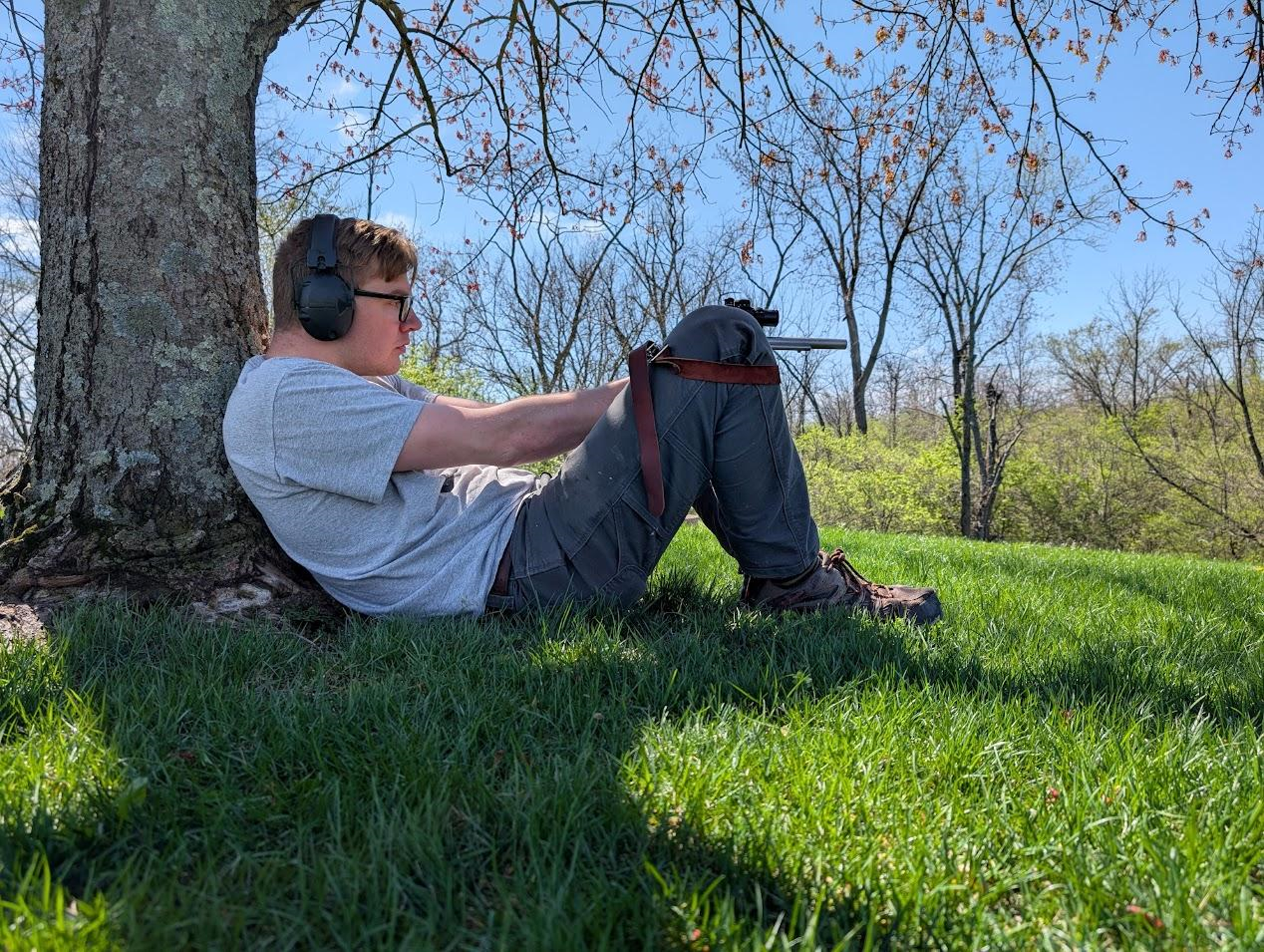
The Sixshot sling from Barranti Leather is a unique product intended to offer a little more stability while shooting from a sitting position. The strap loops around your knees, and the pad in the middle gives you a place to rest your hands or forearms.

It’s not nearly as stable as many of the other options covered here, but it’s much better than shooting offhand. I’ll be using it on an upcoming turkey hunt and could see it being a good fit for still hunting.

When it comes to bipods the list of options is nearly endless. I use an Atlas PSR but have had good experiences with Harris bipods too. The main things to look for are stability, adjustability, and compatibility with the mounting system on your guns. My general experience has been that polymer bipods flex too much to work well, while most carbon or metal bipods are stable if the lockup on the legs isn’t sloppy. In terms of adjustability, I like to have a decent amount of tilt but generally don’t find a need for pan. The more height adjustment the better. Double pull legs and 45-degree leg positions increase the usable height range dramatically.


There’s lots of different mounting systems available. My choice is Arca Swiss for compatibility with my PRS rifles, but most bipods offer some option for mounting to a picatinny rail or sling stud too.

While this list just scratches the surface of what’s available it can still seem like a daunting amount of gear. If you’re just starting out I’d recommend buying a bag or two. For revolvers and semi autos you can’t go wrong with Cole Tac’s bitty bag. There are not many situations where you’ll be unable to build a stable platform with it. For a single shot, many of the popular bags like Armageddon Gear’s Game Changer will work well. From there you’ll have to consider how you generally hunt to decide what will work best for you. A western backpack hunter might want a set of Quick Stix to add a little more versatility to the gear they already carry, while a midwestern hunter sitting over ag fields may be better served by one of Trifecta’s rest. Whatever rests you choose to go with, the most important thing is to hit the range and practice the hard stuff before the season starts.
One response to “Handgun Hunting Field Shooting Positions by: Nick Biederman”
Excellent Article!