
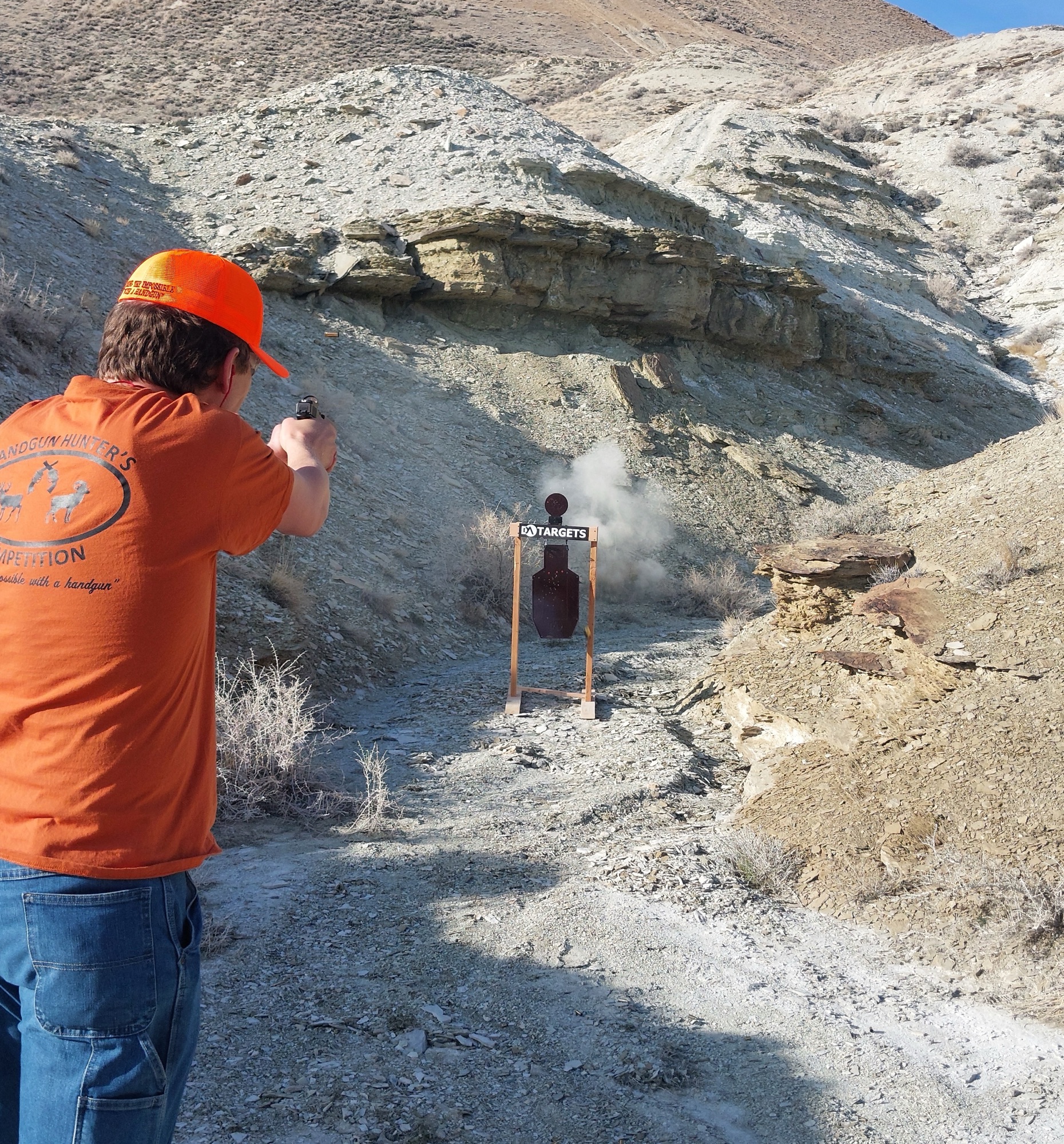
Range days are always good. They’re even better with good guns and good targets.
Handgun shooting and hunting at any distance demands significantly more training for proficiency and consistency than rifle shooting. Paper targets are a staple for zeroing and load development, but for practical training, we need targets that offer instant feedback. Steel targets, with their instant audible and visual cues, have long been a favorite. However, steel comes with drawbacks. Its durability translates to weight, making setup cumbersome. More importantly, the risk of bullet splatter and ricochet is a constant concern. Even at the recommended safe distances I’ve always felt a degree of unease. Over the years, I’ve seen videos and heard stories of bounce-backs towards the shooter that are enough to make me wary.
This led me to seek targets that eliminate these risks, especially as I wanted to practice closer-range drills for my carry pistols and for IPCS/USPSA matches.
Paper (and cardboard) are safe at close range but tracking hits after multiple drills becomes tedious. Even splatter type paper targets can become hard to tell new from old impacts as the range session goes on.
Fortunately, the market has seen an influx of non-ricocheting targets made from self-healing polymer/rubbery materials. These targets often move when hit but provide no visual way to identify where they were hit. That changed when I discovered DA Targets, with their self-healing and color-changing technology.

DA Targets’ patented heat-sensitive material is a game-changer. The bullet’s impact causes minor stretching and tearing, generating localized heat through friction between material layers and between bullet and material. This thermal reaction produces a visible red or yellow circle, depending on temperature.
Intrigued, I ordered a 6” knockdown and C-Zone target in the “Cool Weather” (45-80 F) version, given Wyoming’s unpredictable climate. They also offer “Mild Weather” (60-80F) and “Warm Weather” (60-100F) options.

My initial testing in early March, at around 50 degrees, was revealing. The target’s color shifted from dark red to a brighter red as it warmed in the sun. Starting with 9mm FMJ from my Glock 43X and then the Canik TP9SFX, I was impressed by the distinct hit visibility. The bright red circles were easy to differentiate. The same clarity held true with .22LR from my Browning Buckmark, with the color returning to normal within a minute or two. For a more rigorous test, I used my Thompson/Center Encore in .30-06, firing Winchester 150-grain Power Points at 100 yards. The SP bullets performed flawlessly, practically the same as FMJ, and hits visible through my scope. DA Targets’ robust construction handled the powerful round without issue.
While DA Targets recommends against hollow points, I tried a few shots. HP bullets cut out small pieces of material, creating permanent holes, while FMJ and similar rounds merely tore the material, which then mostly returned to its original position. The tear remains, but the “hole” essentially closes. Even with the less-than-ideal temperature, this session was productive.

A month later, with slightly warmer weather, I returned to the range. This time, I used 9mm from same guns in previous session and 10mm from my Glock 40 MOS. The targets remained dark red, with bright red hits. Eager to see how they performed in warmer conditions, I held off on extensive shooting.

Finally, at around 70 degrees, I returned. The targets were now bright red, with easily visible yellow hits. The color returned to red in about two minutes, slower than in colder temperatures. The color change is indeed heat-dependent.
As the sun set and the temperature dropped, the targets quickly transitioned from bright red to dark. While my thermometer couldn’t keep pace with the rapid temperature changes, the shift was noticeable.
After hundreds of rounds of various calibers, I’m thoroughly impressed with DA Targets. The instant feedback enhances training, improving speed and precision. Their safety at close range is a significant advantage, and they perform equally well at longer distances. The “automatic reset” feature, as the impacts color fades away is a practical bonus. I can shot a group at longer range, wait for target to “reset” and then shoot another one without having to go there and repaint it like has to be done with steel. These targets have proven to be a valuable addition to my range sessions. I plan to continue testing them and I’ll share my observations on social media over the lifespan of the targets.