
Like many folks, 22lr holds a special place in my heart. Whether it’s a $150 Double Nine or a $5000 Vudoo nothing is as fun to shoot as a 22. When I heard Spohr was looking for someone to review their new 22lr revolver I immediately jumped at the opportunity.

100% Machined From Bar-stock

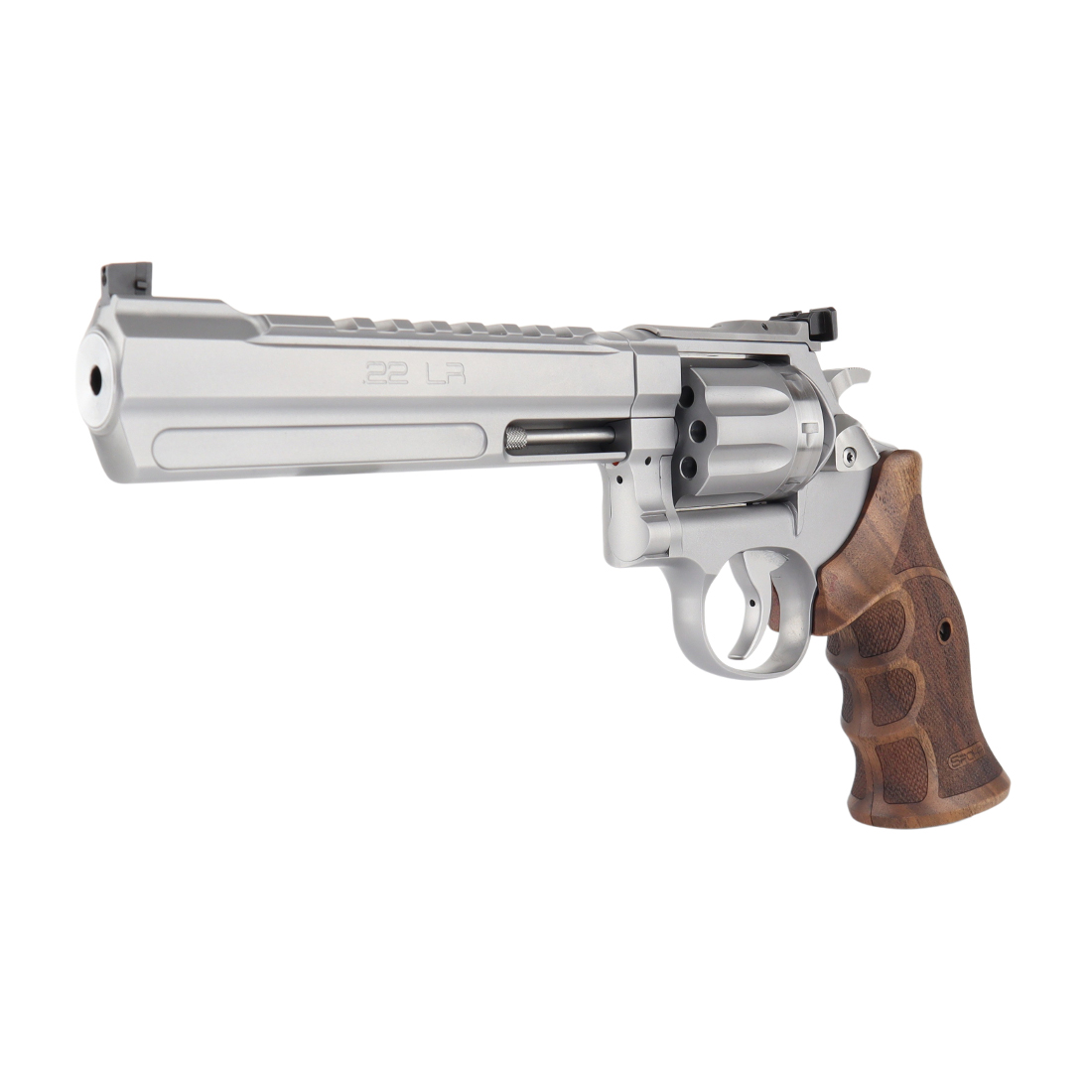
Spohr provided me with their 286 Competition for review. This model comes with a 6″ polygonal rifled barrel and Nill closed back match grips. It came fitted with iron sights and has an integral picatinny rail along the top of the barrel. Unlike most production revolvers, Spohr’s revolvers are manufactured entirely from bar stock. There’s no cast, forged, or MIM parts to be found. The revolver was delivered in a very nice locking hard case.
First Impressions
As soon as I removed it from its case, I could tell it is an extremely well-made revolver. Everything is smooth but tight. Nothing requires excessive force to operate, but there’s no slop. I didn’t experience any binding during the review period. All the joints mate together well.
The cylinder is polished around the lock notches. Polished steel hides minor scuffs better than bead blasted steel, so this will help hide drag lines.

The cylinder release is large and easy to operate, but unobtrusive when shooting.
The cylinder lock up is very good. It’s tighter than any other double action revolver I’ve handled. The cylinder has no perceptible end shake and only a small amount of rotational play with the hammer down and trigger pulled.
Cylinder, Bore, and Trigger Measurements

Right around the time the revolver arrived at my dealer we were hit by a snowstorm then some heavy rain that closed my range for a while. While I waited for the rage to reopen, I took some measurements. I started with the cylinder gap. Smaller is better to minimize gas leakage, but there needs to be a gap for the revolver to function. .002-.003″, roughly the thickness of a human hair, is excellent. Production revolvers often run several thousandths larger. I brought the hammer to full cock, slowly let the hammer down, and held the trigger back while taking the measurement. The .0025″ feeler gauge passed with only the slightest bit of resistance, and the .003″ gauge would not start.
The Bore
Next, I gauged the bore. I’m not looking for a particular dimension here. I’m looking for the largest gauge that starts in the muzzle to fall all the way through. This indicates there’s no belling or constrictions. The .215″ gauge slowly slid through under its own weight, while the .216 wouldn’t even try to start.
After checking the bore I gauged the cylinder throats. I’m looking for consistency here. One throat would pass a .221″ pin. All 8 would pass the .220″ pin.

Lastly, I measured the trigger pull. The single action trigger is excellent, breaking crisply at just over 3lb with no perceptible creep or over travel. The double action trigger is smooth and consistent and exceeds the 8lb limit of my scale.
Precision Testing

Once the range reopened, I moved on to precision testing. I mounted up a Leupold 2.5-8x scope with a mount provided by EGW and hit the range. EGW’s Smith and Wesson mount fit perfectly and let me mount the scope in a more comfortable position than the integral rail. In total I had 17 different types of ammo to test. I shot 3 different lots of Lapua CenterX as I had it on hand and it’s not uncommon for there to be meaningful performance variation between lots of match grade ammo. I shot one lot of CenterX twice as I felt like I pulled my first shot. Both groups have been included in the results.

The gun was thoroughly cleaned, then I shot about 25 rounds of the ammo to be tested through it. I ran a wet patch followed by a dry patch down the bore, fired 8 fouling shots, then fired 8 shots for record. When switching between lots or lines of ammo from the same manufacturer I ran a wet patch followed by a dry patch, fired 8 fouling shots, then fired 8 for record. When switching between brands or bullet construction I thoroughly cleaned the bore and cylinder then repeated the procedure described above.
Accuracy
All shooting was done at 29 yd- the distance measured with a rangefinder from bench to target on our 25 yd range- using MTM’s FRR-30 rest. Measurements were taken with the Range Buddy App. All the target pictures are at the end of this article, and the group size measurements are in the table below.

Unsurprisingly, Lapua’s match ammo was the best performer. It’s also the most expensive ammo tested. In terms of inexpensive, readily available ammo CCI’s SV and Federal Champion both proved to be solid performers, producing groups just under 1”. CCI’s Mini Mags generally performed well, with one outlier expanding group from.65” to 1.11”. In terms of hunting ammo, CCI’s SGB produced the smallest groups and has proven very effective on squirrels and rabbits.


Field Shooting

With the precision testing completed I switched my focus to shooting from field positions. I swapped the scope for an Ultradot Matchdot II and headed down to the family farm. Ultradot’s optics have proven to be durable and reliable in every situation I’ve used them in. I’ve used their Matchdot II on other revolvers, but this is my first time using the newly upgraded version. There’s been several improvements, most notable of which is the inclusion of “off” positions in between each level of intensity on the brightness knob.

I spent several days putting it through its paces. Shootability from field positions is very good. My hands felt cramped while supporting the butt of the grip with a bag. A different grip, like Hogue’s Big Butt or Nill Match Master, would be beneficial when shooting with the butt resting on a bag. Any grip designed for Smith and Wesson’s L frame revolvers will fit with minor interior modification, so there’s plenty of options out there.
The Grips
The stock Nill grips are very comfortable. They fit my hands well and worked great in every other position I shot from.

I had no problem keeping my shots on a 12″ plate at 200yd.
Ultradot and Adjusting Drop
The Matchdot’s elevation turret made it easy to dial from 50yd out to 200yd. It tracked reliably and accurately. My Kestrel provided accurate DOPE as far as I could shoot. The Spohr 286 combined with EGW’s mount and Ultradot’s optic makes for an excellent platform.
Iron Sights
While I’m not much of an iron sight shooter, I did try out the stock sights prior to returning the test gun. The sights were easy to find and plenty precise for me. My skill with iron sights is the limiting factor in terms of accuracy, not the sights themselves. They’re click adjustable for windage and elevation.


The two-stage front sight has a small portion that can be extended upwards .030” and is retained in either of its two positions by a spring detent. This provides about 12 MOA of elevation adjustment.
Summing up the Quality
This revolver is one of the finest revolvers I’ve had the pleasure of shooting. The fit up and machine work is excellent. Everything is tight but smooth. Based on my testing it seems to be a bit pickier about ammo than other 22lr handguns I’ve shot but provided very good precision with several loads tested. When paired with a high-quality optic and mount it provides an excellent platform for field shooting. Spohr’s lineup of 22s currently consists of the 283 Carry, 284 Carry, 285 Universal, and 286 Competition with 3″, 4″, 5″, and 6″ barrels respectively. The two carry models are fitted with Nill combat grips while the Universal and Competition come with Match grips. All four come with a bead blasted stainless finish.
For more information on Spohr Revolvers check out www.spohrguns.com
By: Nick Biederman
2 responses to “SPOHR 286 22LR Review”
Nice weight up Nick
[…] Here is a link to the article: SPOHR 286 22LR Review – Handgun Hunting Afield […]