
“Let’s go to Arizona and hunt javelina this winter,” my friend quipped.
Nearing retirement with the Game & Fish Department and looking forward to starting a new career, it sounded perfect.
“You bet,” I replied without hesitation.
“OK, another coach I know went down last year and saw lots of them. I’ll get with him and check out the application process,” he said.
With the idea firmly in pocket, my friend, who is also a retired biologist, began to plan our hunt. He opened a party application and another retired game warden friend joined in.
Arizonia is one of a growing number of states that require you to purchase a basic hunting license before you can apply for a big game tag. In this case, the license, application fee and license cost seemed reasonable; and after a couple months we had our javelina tags in hand.
Arizona offers both fall and spring javelina hunts. Depending on the unit, a hunter may take one in each season. They also offer spring HAM (handgun, archery, muzzleloader) seasons, including the unit in which we were planning our hunt. Unfortunately, one of our party couldn’t make HAM season dates work. So, the tags we drew were valid for the General season that opened the following week. A season that also allows handgun hunting.
Arizona’s spring hunt is in February, which is far from springtime in my home state of Wyoming. With a 30 degree below zero morning a couple days past, my friend and I loaded up and headed south.
We rendezvoused with our hunting companion and another retired game warden friend, who was along to help and enjoy the hunt with us.
The next morning, we wandered onto the public land we were going to hunt well after the sun had risen. Being not real sure of where we were headed relied on some waypoints my friend’s coaching companion had provided. We didn’t want to stumble around in the dark. Instead, we felt it best to let it get light and then get the lay of land.
For this hunt I had my .357 mag BFR in a chest rig and my 40+year old G1 Contender in .223 Rem strapped to my pack. The BFR was chambered with handloaded 158 gr XTP’s leaving the muzzle at 1,550 fps. In my pocket, was factory ammo for the Contender. Except for euthanizing cripple and diseased animals in my past profession, I have never taken a big game animal with anything but my handloaded ammo. Without a lot of time to work up a load for the Contender I tested three types of factory ammo and settled on Ammo Incorporated’s Hunt LRloaded with Hornady’s 60 gr V-Max. This combination produced 0.75 MOA three shot groups and a muzzle velocity of 2,815 fps from the 14-inch barrel. To get the bullets on target, a Gen-2 30mm Ultradot topped the BRF, while a Burris 3-12X pistol scope was mounted on the Contender.
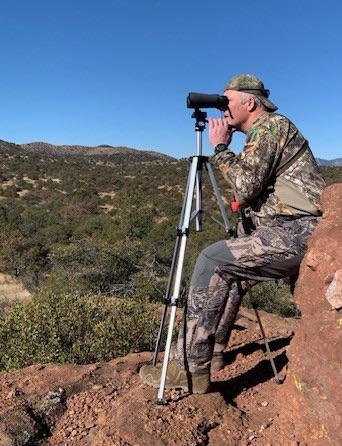
Our hunting party decided to split into pairs. So, my friend and I, who was on his first handgun hunt, took off to cover ground and learn some county. Quickly, we realized the terrain and habitat didn’t offer an abundance of openings – and glassing an already hard to detect critter would prove very challenging at best. The habitat is what I would call desert oak and juniper chaparral (scrub brush) with cactus and shin dagger yucca and agave. In all likelihood, if we found a javelina to take a poke at, it would either be well within revolver range or at fairly long distance.

About an hour into our first day of hunting, we eased over the top of a ridge. There, just 15 yards ahead, a little grey bush presented itself to my friend, but it wasn’t a plant. Instead, it hopped up and ran off. Our first javelina sighting, and seven more of the little pigs squirted out following the first from their nearby day beds. All we could do was watch them scurry away. Oh well, it was a start.
Actually, javelina are not true pigs, but peccaries, of which there are three species. The collared peccary (javelina) is the most northern occurring species.
Peccaries are basically the America’s equivalent of European, African and Asian wild pigs, which are the stock the wild and domestic pigs we are most familiar are descended from. Since javelina are native to Arizona, they are well adapted to avoid predation, especially from stumbling,bumbling hunters!
The fleeing javelina were the only ones we would see our first day, but the experience gave us a plan. Since shots would likely be under 100 yards, or at much longer ranges, we decided my friend would carry his Performance Center .44 Mag. to handle the short stuff, and I would pack the Contender to reach out if need be. His would be the first shot, and the goal was to set him up for his first handgun harvest.

Day two of the hunt produced zilch for javelina in the morning. That afternoon we drove to a spot about 20 miles away. About the only other vehicles we saw were numerous Border Patrol, and the car’s thermometer topped 89 degrees. So, we parked and shaded up until late afternoon.

We hit the trail about 4pm, poking along slowly and pausing to glass. After a bit, we found ourselves at a stock pond with a number of javelina tracks leading down to the water’s edge. Normally, javelina only need to drink every two or three days, but we decided setting up on the edge of the pond might be the ticket. We moved to the southeast corner of the stock dam, settled in, and waited.
After an hour and a half, my friend suggested we mozy along and continue still hunting. I had just finished strapping my pack on when two javelina appeared heading straight to the water. Down I went, simultaneously removing my back and going for the Contender. Meanwhile, my partner, new to handgun hunting, was trying to get out of sight while taking his pack off and fumbling at his chest rig. But, when dropped his pack to the ground, the “skunk pigs” turned tail and sped off.

Lessons learned – javelina really can’t see well, and my friend discovered that one of the benefits to backpack handgun hunting is that you can simply draw, get into position and fire quickly if need be. Unlike his back pack rifle hunting experiences that required him to remove a bunch of gear and then get into position. Happy we saw javelina again, we hunted our way back to the car and headed “home.”
Day three found us covering the same ground we had the previous two mornings, but to a prechosen spot where we sat and glassed areas with prevalent javelina sign. With no javelina showing themselves after a few hours, or at least our not spotting one, we spooled up and began to explore new ground.
About 10:30 we discovered another stock pond. This one was loaded with javelina tracks around its edges. After the previous evening’s experience, we decided to set up on the waterhole.

What a day we had. Sitting in the shade of a huge oak tree we watched brilliantly colored birds, found only in that part of the world, come drink and fly away. I added over a half-dozen birds to my life list. A coues deer and her fawn also came in to drink. It was just an awesome experience sitting there enjoying the wildlife.
Pondering our options, we decided to stay at the pond until dark to avoid an incident similar to the previous evening. As noon passed, we figured we would have quiet a wait on our hands. Both of us settled down on our partial pieces of old blue sleeping pad (a great thing to bring along for cushioning when glassing) and took a nap with the top of our heads against the big oak.
Grunt, snort – the noise woke me. Javelina? Then I heard it again and eased myself up peering around the tree. There, 10 yards away was a javelina trying to figure out what we were. Slowly moving down on to my back again, I whispered and motioned to my just waking partner. He tried to slowly put his earplugs in and unholster. That was enough for Mr. pig. He was out of there. All we could do was laugh at ourselves in disbelief. We never thought a javelina would come in to water in the middle of the afternoon – wrong. As we found out later from a Forest Service employee who stopped by the pond to look for leopard frogs, the year had been extremely dry, with almost no rain. This particular stock pond was down to one-quarter its normal size for February, and the temperatures were unseasonable high. Ah, that’s why the waterholes were productive we reasoned.
A couple more hours wore on and we repositioned to another spot, set up our gear, and waited. We took turns keeping lookout. No more sleeping on the job.
About three o-clock I spied a critter headed to the pond. It was a coatimundi – no way! My friend and I had never seen one in the wild and were hoping to. I nudged him to move my way and take a look. We were both stoked. It was the wildlife viewing highlight of the trip.

4 pm – We moved onto the dam face to stay in the shade and have a good view of the entire pond. After a bit, my friend moved down the small earth dam to answer nature’s call and have a snack. I pulled out my elk jerky and was fumbling with it and the mouthpiece of my water bladder when my friend eased back up to our hide and suddenly said, “Here they come!”
I looked up with a mouth full of jerky and saw four javelina motoring in for a drink. My friend set his revolver on his Cole-Tac bag, which rested atop a bog-pod tripod. I slowly stood my pack upright, grabbed the Contender, and placed the forend onthe top of the pack frame – jerky still in my mouth.
The lead, and biggest javelina, stopped a few yards short of the pond and turned broadside. 40 yards – a perfect revolver shot for my friend. As I watched through the Burris scope, my DefendEar electronic ear plugs muffled the sound of his shot.
It looked like he may have hit the pig, but I wasn’t sure and the peccaries scattered in four different directions. The target of my friend’s shot made a wide circle to the left moving uphill and away from the pond. I tracked the pig in my scope, unable to tell for sure if it was hit. No blood, no wobble. The javelina then stopped broadside about 90 yards away. If it stopped, maybe it was hit. Deciding quickly that wounded or not we couldn’t let him get away, I touched off a hastily aimed shot and the javelina crumpled. Its legs twitched, and then it was still.
At that, my hunting partner got a little grumpy.
“I was on him. Why did you shoot?” he snapped.
“Well, I didn’t want a wounded javelina getting into the brush, and wasn’t going to wait,” I said.
He was frowning at me and I was feeling pretty bad at this point. We ensured our guns were safe, gathered our gear, and walked slowly towards the carcass. Reaching the dead javelina it was apparent why the adult boar crumpled. My shot placement was perfect left and right, but high and I severed his spine. Reminder to self – when shooting one handed off the top of a pack framewith a forend rest, recoil will tend to make your impact rise. Plus, I probably was high on my aim too. At any rate, it was a quick, clean harvest.

All peccaries have a scent gland near the top of their rumps.Hence, the nickname “skunk pig.” One needs to be very careful field dressing them to avoid puncturing it and setting off a real stink bomb. We were told to skin them from the belly up instead of top-line down before quick quartering to avoid puncturing the scent gland. So, we started in. Talk about upside down and backwards. This foreign field dressing process on such a small animal was actually a struggle when you’re used to the opposite on much larger beast. We also discovered these little guys are dang tough hided.
Working together, we got one side skinned and the quarters and meat along the spine removed.
Only, one wound channel was apparent, but there was also what looked like an entry wound on the hide below the exit wound caused by the 60 gr V-Max. Had we both shot it? Afterall, it was facing south when my friend shot and north when I fired.
There’s working rule we always used when I was a game warden and taught in hunter safety. That is, if two people legally shoot at the same animal, the last shot is assumed to be the killing shot; and the person who took that shot was to tag the animal. Obviously, in this case, that was me.
We finished the skinning and quartering job. As I was putting my gear away after filling out and dating my tag, my friend hauled the carcass away and stashed it in the brush. He returned and loaded up his stuff. Then he said, “I need to go look at that carcass again and see if I can tell if I hit it or not.” About 10 minutes later he returned.
“It’s your pig,” He said, and continued, “That hole must have been the core of your bullet, if I had hit it there would have been an exit wound, and there wasn’t.”
Then he said, “I don’t know how I missed. I had a great hold. He was well within range and I thought the shot was good. But, it is a good thing you shot, because had I wounded it, I don’t think we could have found it. I dumped that hide and carcass about thirty yards away and even knowing where I put it, I had a hard time finding it again. We never would have found that thing if it had gotten into the brush and died.”
This made me feel a little better. We donned our packs, meat and skinned skull securely stowed, and made the hike back to our vehicle. Getting back to our Air BnB before dark, we got the meat in the freezer, cleaned-up, and headed into town for a great steak dinner.
4 responses to “Hand-gunning Javelina by: Joe Sandrini”
Excellent story. I bet it was a bit of a shock regarding the temperature difference.
Love hunting desert Javelina. Friend to a couple of Javi’s on my property, no longer own, out in Sanderson, Texas… I’ve taken 1 out in Jourdanton, Texas south of San Antonio w my 7-30 Waters 14” 140gr Nosler BT. The desert Javelinas hide/hair were coarse and bristly. The Jourdanton javelina’s hide was as soft as a rabbit hide except for the top hairs. Wanted to shoulder mount it but the stink and unfortunately dull knives forced me to take a European mount. Took 2 days to get the smell out of my nose. No boar hog ever smelled that bad but the meat was delicious…
Javelina looks like a fun hunt. I do believe that Texas is the most practical place to hunt them for most of us.
Drawing a tag in AZ is nearly OTC…..