
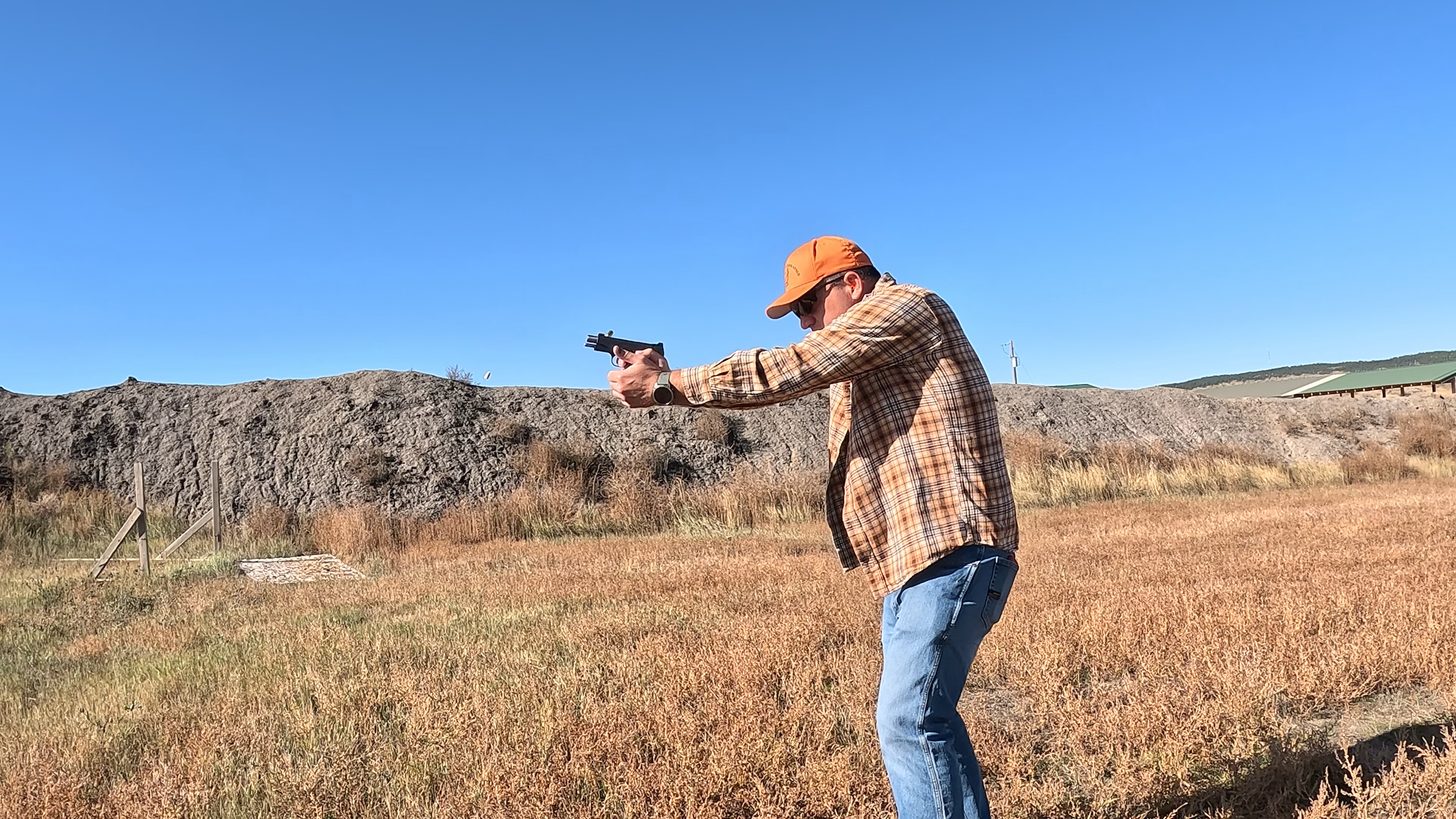
The first rule to a gun fight is to have a gun. Although you are far more likely to die of old age than to ever need a firearm in self defense, it is still important to many of us to protect ourselves. There is a lot that goes into the considerations on what to carry and how to train. In this article I will detail what I carry and some of my basic drills I practice.
The Experts
First I would like to touch on a major topic in the firearms world, experts. The word expert gets thrown around way too easily in my eyes. We do not really have any form of governing body to label someone an expert besides the courts. The courts have a pretty low threshold to label someone an expert. The court standard may vary by state but in general an expert needs to know more than the average person within the profession. Taking that statement at its face value; it’s a pretty low bar.
I’ll use myself as an example. I was a K9 handler and trained two dogs that passed certification. I worked both dogs on the streets with success. That alone was enough to get me certified as an expert on the working dog.
In my eyes, to certify someone as an expert on the K9 I would want them to have a whole lot more experience. Decade or more on the streets, years in the court room, multiple legal trainings, and advancing up the ranks to kennel master or master trainer.
To me, and likely many of you, a much higher standard is set for an expert. We would label someone an expert who does a particular task or skill repeatedly or continuously. Not once, twice, or just has a theory.
Where is all this explanation going? I am not an expert on self defense. Sure I have a background in the USMC with combat awards and time in law enforcement, but I am not a self defense expert. I just have some experience.
To be an expert on self defense I would have to defend myself constantly, repeatedly, and often. In my opinion we have very few people out there who would rise to the level of expert.
Why did I take the time to explain my thoughts on experts? Well it’s important that you seek out training to expand on your self defense skills. It is also important that you research who you train under. Find the instructor who stays current, who isn’t afraid to compete in shooting competitions, and doesn’t place themselves on a pedestal.
I do have my own experiences and theories on self defense and equipment which I will share here. These are based on my professional careers, training, and other real life experience.
Accuracy
With the first rule to a gun fight being to have a gun, obviously we are going to talk about carrying a firearm. Carrying a firearm comes with real responsibility and liability that one must consider. I’m going to touch lightly on the liability side that so many seem to miss.
If you ever have to discharge a firearm in a defensive situation you are liable for each and every round you fire. You are liable for any unintentional item or person it may strike. Training to just dump rounds down range and hit a large target is setting yourself up for failure. Accuracy is not the hot topic in the firearms world, but it should be. It doesn’t look as cool to place a few rounds exactly where they need to go as it does to spray away on Instagram.
My training practice always includes precision shooting. Every current production handgun is capable of placing the entire cylinder or magazine worth of ammunition within a fist size target at 25 yards. Precision shooting does not mean you are shooting slow. With time and practice you will be able to place rounds on target very quickly and accurately.
With mass shootings on everyone’s mind, we know it’s a possible scenario that you may have to engage a rifle shooter with a handgun. Some of these nut jobs are even using body armor. That just potentially made the target smaller and farther away. Your handgun is more effective at distance than the internet will tell you, just look at our hunting articles on HHA.
Training
I like to work the majority of my drills from 5 to 25 yards. Mixing in movement, shot angles, different positions, and different target sizes. At under 10 yards I work on quick engagements. Multiple rounds fired using a shot timer. I push myself to go faster while maintaining accuracy. Maintaining A zone hits on a USPSA target is a good goal.


I tend to shift my aim point to the top of the chest A and I am fine with hits above that in the C zone. The C zone above the A is often an uncovered area when we talk about body armor. That is also about the line a bad guy would hold their firearm when presented. We know from multiple law enforcement shooting studies that your eyes will probably focus on the target’s firearm. It’s just human nature, the gun is what you see as the threat and you will focus there.

As you become more proficient you will bring your firearm inline with wherever your eyes are focused on naturally.
Practicing beyond 10 yards I shift to controlled pairs. To me this means firing two shots with one sight picture. I will also practice failure drills which is the controlled pair center mass and then one to the A zone in the head.
I do find that it is important to practice beyond 25 yards. Once again, it is possible, although unlikely, that you will have to engage someone farther away. Beyond 25 yards I practice absolute accuracy. I push the speed as much as I can, but hitting the target precisely is more important here.
With all of my training I incorporate the draw as much as possible. I also find working on the draw during dry fire to be beneficial.
Expanding your Training
Thank goodness we do not get in gun fights every day. But there is one place we can get some adrenaline going and get the pressure of being on the clock, competition. If you want to be prepared I highly recommend that you take up competitive shooting. You will be forced to plan, move, shoot, and deal with weapons malfunctions on the clock. No training class will prepare you the same way competition will.

There are quite a few good classes and instructors out there as well. Good training will go a long way in helping you form a plan for the worst case scenario. A good instructor will work you through simulations on the range that you can then go home and continue to work on. I stress the good instructor part; do your research.
What I Carry

Now once again; I do not claim to be an expert. I have relevant experience but I am still learning every day. When I carry a firearm I like to keep it simple. We have a lot of push from the industry telling us to carry more stuff on our person than I carried as a cop. You can only carry so much gear, and we are not loading up for war.
I don’t pack a gun and kit in preparation for a horde of mall ninjas or have some fantasy about Red Dawn. I carry what I need to ensure I can egress away from the situation to a safe place and live to see another day.
In my mobile safe place, my vehicle, I carry all the extra stuff the crowd tells us we need. Trauma kit, extra ammunition, and other gear.
Pocket Carry
My normal everyday carry is a Smith and Wesson J model 432 in 32 H&R magnum. This revolver provides me with a capacity of 6 rounds and I carry a speed strip with an additional 6. I carry this gun in a pocket holster as I find that to be the most convenient. This allows me to meet that primary goal of having a gun in a gun fight.


I have tried small pocket autos and find them to just be more difficult to shoot accurately. Sure some carry more ammunition. But none will be as reliable when exposed to the dirt and grime of pocket carry.

The 32 H&R mag is far more controllable than the 357 magnum J frame I carried as a back up when I was a cop. I always qualified with a 100% score with that 357 but it was a lot more difficult. J frames are intended for close range use and I do not feel under gunned with the smaller projectile. While training with the J frame I practice to contain those rounds within the upper ⅓ of the chest A zone on a USPSA target. This provides the best possible outcome using the smaller projectiles based on my experience.
Having taken a lot of game with a handgun and witnessing the terminal performance first hand of various bullets; this may be the area where I rise to the level of expert.
On the Hip
When there are options for more concealment clothing I opt for larger firearms. Long ago learning all the firearms safety rules, there was one that stuck with me. Never point a firearm at anything you are not willing to destroy. Appendix carry is all the rage. Good luck with that and sitting down. That one popular (or once popular) gun brand that likes to go off on its own should be a wake up call. It is possible for a negligent or accidental discharge to happen while carrying a firearm. A round passing through that area of your body will be a mess for even the best surgeon to fix.
Hi Cap

Inside the waist band just behind the 3 o’clock position is where I generally carry larger guns. I use both kydex and leather holsters. Leather can be a little more comfortable but kydex offers easier reholstering.
My preferred carry is a Walther PDP Compact in 9mm. This gun is set up with a Trijicon RMR that I have had forever. It also has cowitness sights and the gun is Magnaported. The Walther is extremely fast on target and I can rapidly engage with it due to the red dot. Porting allows for extremely fast recovery from recoil and follow up shots. The increased speed of engagement becomes more apparent as the distances lengthen. With this gun holding 15 +1 of 9mm I generally do not carry spare ammunition on my person. I am responsible for every round I fire so I fully intend to be judicious with each one.


Slab Sides
When I need a thinner firearm for concealment but I can still cover it up I opt for a 1911. When carrying a single stack I prefer to go ahead and increase the caliber. If I am giving up capacity in the auto I may as well carry a bigger bullet. Once again the industry likes to tell us how 9mm will do everything but that simply is not so. This is once again something I can back up with my years of handgun hunting experience.


A 45 acp gives me more bullet weight and more diameter striking the target. In a 1911 it is not a problem to control the larger round. For a 1911 I chose an older model Kimber commander light weight. It has an alloy frame with steel slide, fiber optic sights, and a laser grip. Laser grips are fading away in popularity as red dots become more common. I am sure in the not so distant future I will replace this gun with a red dot capable 1911.
When carrying a 45 acp 1911 the capacity is limited to 8 +1 and I choose to carry an extra magazine. 1911 magazines are flat and thin which makes them easy to carry. I simply slip them into my pocket.
Road Trip
When on a road trip where I will spend an extended amount of time sitting I opt for an alternate way of carrying. Accessing a firearm while sitting is more difficult and that needs to be considered in your plan.
I opt to use a sling bag on road trips. I can secure it around the seat while driving allowing for quick access. Upon exiting the vehicle I can put it on. These types of bags are becoming more popular for people to carry everyday items in and not just guns. They do not seem to draw the attention like the fanny packs did back in the day.


I like to mix in some draw and presentation training with the sling bag before any road trip. Within the bag I can also carry other small items I may need such as magazines, flashlight, pocket knife, and more.
Considerations
When I step out the door with my personal safety in mind there is a lot I have to think about. A good bit more than just a firearm. In addition to keeping my head on a swivel I do not want to alert the public to my possession of a firearm. Keeping the firearm out of sight is paramount in my carry consideration for each trip outside of my home.
Seek training, push your limits, compete, and have a plan. Hopefully the day never comes where you or I need a firearm for defense, but we should be ready if we do. I hope that sharing my experiences and choices with you will help you on your path to self reliance and personal safety.
One response to “What I Carry by: Chris Rhodes”
[…] a defensive shooting scenario I would never expect to be perfectly stable. I also never expect to be perfectly stable […]