
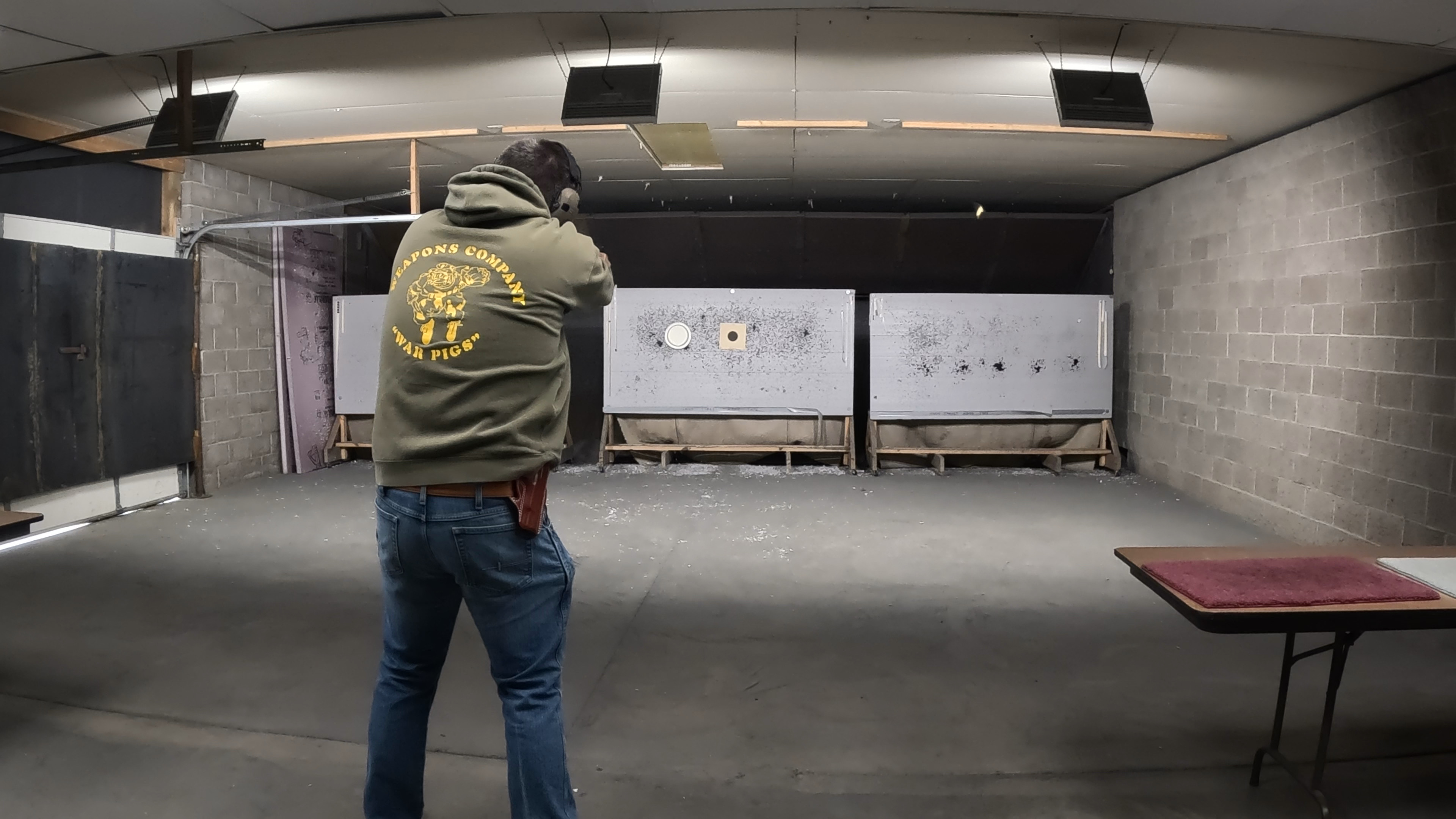
If you have shot any firearm for accuracy you know there is some wobble in your body and sight picture. Many try to defeat the wobble with supports, rests, and benches. While that is one method; a more productive method is to embrace it!
The Bench
Where do I use the shooting bench? Zeroing, load development, or other accuracy testing. Beyond those things the bench is unproductive for real life shooting unless you are competing in bench rest competition.

Sure tight groups look amazing when published in a magazine or online but that’s about their limit. I highly doubt you will have a shooting bench when you are hunting in the field, defending yourself, or running around a course competing.
Even if you are in an advantageous position in a shooting blind or stand with a shooting rail, odds are you won’t be bench rest stable. You probably won’t have front and rear support or you will have to turn your body to engage your target animal. Those same “problems” would apply to all types of shooting.
Failure to Keep Pace
I watch competitors every year at Handgun Hunter’s Competition attempt to get bench rest stable. They are searching for that perfect sight picture and they want the sights to be dead still. I also watch them run out of time or end up having to rush later on the course due to par times.

With field shooting no matter the firearms type or the use there will be movement of the sights on the target. The only way to possibly escape that is with heavy bench rest guns and high end rests.
Qualifying
Long ago in the United States Marine Corps they taught us that when in position the sights would move about the target. The instructors stated that this movement would be similar to a figure eight. We were trained to watch this movement and then time the shot to break as the sights crossed the target. You could have the tightest loop sling on with your rifle and be in the tightest position but there will be movement.
Our rifle quals in the USMC replicated a high power match with a twist using man shaped targets. At 300 yards I would watch that sight work across the target. As it started to swing back towards the target I would prep the two stage trigger pull. Just before it crossed the center I would begin my trigger press. This same method also applies to handguns.
Realistic Accuracy Goals
With extreme accuracy shooting like I have written about in the past on Handgun Hunting Afield I apply these same concepts. It is impossible for me to hold the gun precisely on target. Instead I am looking for the moment that the gun is on target and capitalizing on it.
The first thing you have to grasp is that the goal is not a tiny group. The goal is to hit the desired target. To focus this on hunting the goal is to hit the animal in the vitals. For most big game in North America the vitals are 8 to 10 inches in diameter.

My goal when practicing to hunt is to hit that 8-10 inch target 100% of the time at the desired distance. I do not care if it is an 8 inch or a 1 inch group. Keeping my hits within the vital size area will give the desired hunting results.

This same concept can also be applied to defensive or tactical shooting. On a USPSA target the A and possibly the C zone are all vital areas.
Shifting to Hits
By shifting our goal to hitting the desired target versus shooting tiny groups it allows us to pick up our speed of engagement. Shooting for pure accuracy and small groups we all take a great deal of time focused on sights, target, trigger press, and so on. When focused on hits you are breaking the shot as soon as the sight crosses the target.
This also allows us to shoot from less stable positions. By looking for just a small moment in time when everything is lined up you can be less stable.

In a defensive shooting scenario I would never expect to be perfectly stable. I also never expect to be perfectly stable when hunting with a handgun. I practice setting up quickly and shooting. When hunting I expect to fire in less than 5 seconds once the shot presents itself. This applies when I am shooting revolvers from zero to 200 yards. It also applies to my single shot handguns I am pushing beyond ¼ mile.
So far this season I have not had time to dilly around for a shot. All of my animals required quick shooting from less than perfect positions. All I needed was a moment in time when the sights referenced the target precisely.
Training
Training for this requires you to push yourself away from the comfort of a bench. Leave the complicated tripods and rests behind. You have to invest in range time. I recommend starting in the hardest position, standing. Place a target of reasonable size such as a 8-10 inch paper plate at a modest range of 10 yards.

As soon as your sights are on the target press the trigger. Repeat this process and pick up the pace. Investing in a shot timer will also help. The shot timer can be set up to give you the start tone at random which will simulate various real life situations. A timer also adds some stress and allows you to keep track of your times. The goal here is to increase our engagement speed and it won’t happen overnight.
With time you will be able to take the 10 yard target and move it farther out. I use this same concept shooting to extreme distances with revolvers and single shots for hunting.
For defensive use the basics remain the same. You can still use the basic paper plate size target but a USPSA target may be more relevant here. Keep pushing faster and keep all of the hits within the A/C zone.

Advancing your Training
For hunting I like to mix in follow up shots. It has happened to me and if you hunt long enough it will happen to you where the first shot is not perfect. Following up quickly is important to humanly dispatch the animal. I practice reloading my single shot and re engaging as quickly as possible. With the revolver I also practice for the repeat engagements.


For defensive shooting mixing in failure drills, reloads, and movement is a good idea as you progress.
Summing it Up
Tiny groups are great, but in real world situations we need realistic accuracy goals. A hit is a hit as long as it is within the desired zone. By embracing the wobble verses trying to eliminate it you will become a better field shooter. This will allow you to be more successful in the field with less missed opportunities and better prepared should something go bump in the night.