
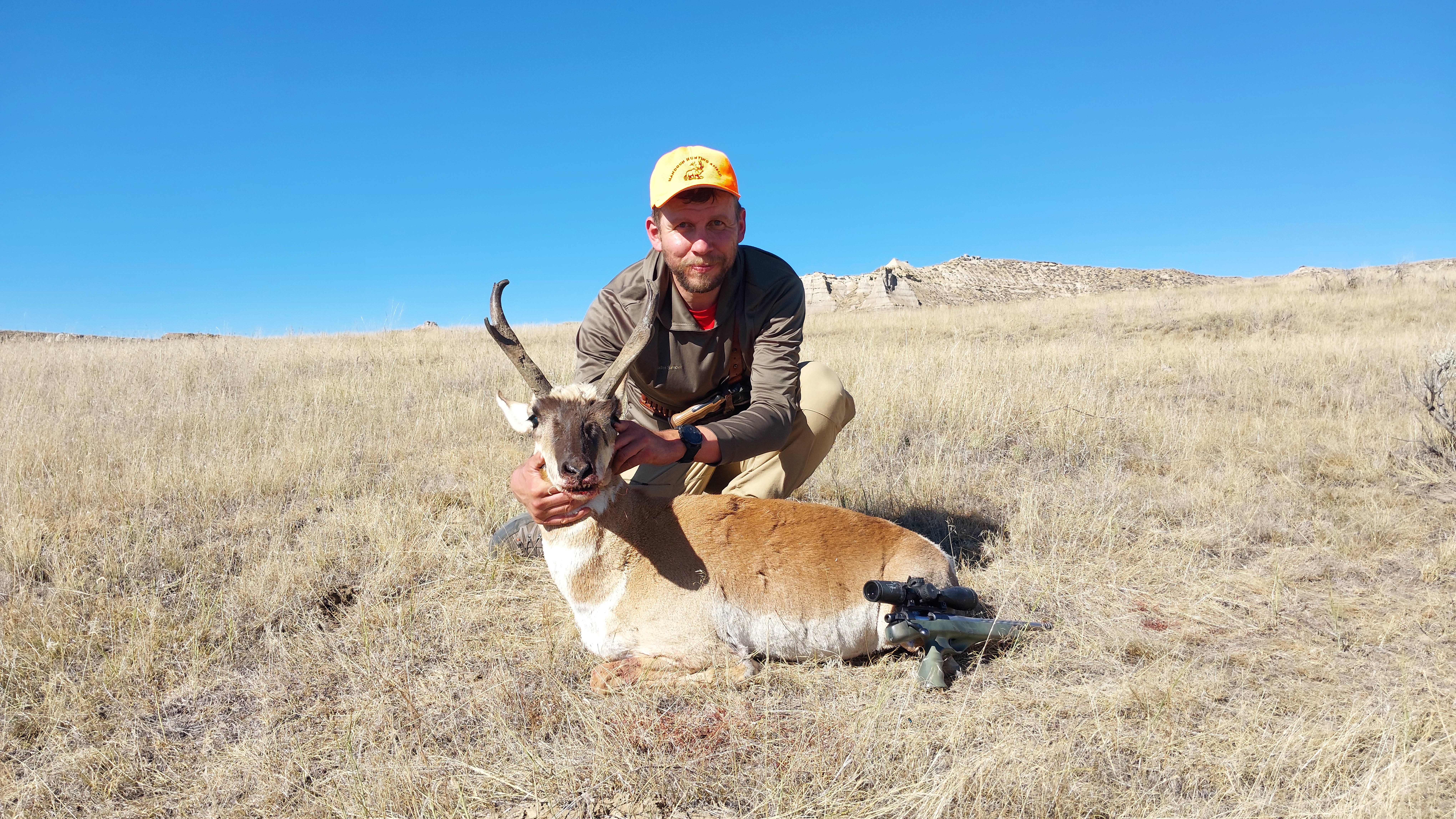
The animal known by many names—speed goat, antelope, pronghorn antelope, or just pronghorn. They are the only living species in their family, and their closest living relatives are giraffes, not antelopes. Some say that pronghorn is their only correct name. Through evolution, they developed several remarkable traits: incredible speed, endurance, and exceptional eyesight. As the second-fastest land animal in the world and the fastest in North America, pronghorns can maintain speeds of 40–45 mph for miles. If “boosters” are turned on, they can even exceed 60 mph for short bursts. They are the only horned animals with a horn branch/prong, and the only ones that shed their horn sheaths annually. That trait is usually reserved for antlered species.
Pronghorn Capital
Wyoming is considered the world’s pronghorn capital, and with nearly half of the state being public land, there is no better place to hunt them. The odds of drawing a tag, even for residents, depend on the specific area. Areas with better access and higher trophy potential are difficult to draw; conversely, areas with limited access often have a 100% draw success rate, even as a second or third choice. My tactic is to apply for a high-quality area nearby as my first choice, and then apply for easy-to-draw areas as my second and third choices. All those areas are far from me, but I would rather drive far and hike deep into the area than not hunt at all. In addition to a buck tag, I always apply for doe tags. This year, all the tags I drew were second choice. I knew well enough to adjust my expectations; the buck has to have prongs above its ears to be a shooter. Most likely, I won’t have the luxury of being picky, but as long as I get to enjoy the hunt, that is all that matters to me.
Late Season
After some early-season luck with my mule deer and bull elk hunts, the pronghorn was next on the list. I waited until the first week of the season ended, hoping to avoid the bulk of the crowds.

At first light, I began my hike. It wasn’t long before I spotted a lone buck, followed by an entire herd. Unfortunately, the buck was on private land, and the herd was over a mile away. After checking on the map and realizing that the herd was most likely on private land as well, I decided to climb the nearby ridge and glass the other side of it.
Distance

The terrain was full of draws and other ridges. After “just one more ridge” and “just one more draw,” I was about 3 miles in when I spotted a herd of about 25 animals—mostly does, but with 3–4 bucks as well. None of those bucks were huge, but two looked good enough for me. Since they were at about 2 miles away and had disappeared from my sight, I didn’t rush there right away. I decided to keep checking various ridges until I spotted them again; they were right next to the property line but on public land, bedded down.
Closing the Distance
I used a draw to get closer until I reached the property line and realized that I couldn’t use that draw any further. Instead, I climbed out of the draw and started crawling. It was not easy, and it was very slow. Not having any cover other than a few sagebrush bushes didn’t help either. Once I ran out of cover, I tried crawling a little more, but it didn’t take long before the animals started noticing me. I ranged them, and I was at 275 yards.
Choices
The biggest buck was still bedded and surrounded by does. A revolver was not an option since it was outside my max range. There were two options: one was to use a single-shot pistol—an XP-100 in 308 Winchester loaded with 130-grain MTH from Cutting Edge Bullets—the second option was to back out and try finding them again later that day or another day. Having hunted the same area last year, I knew that I might have a hard time finding them or any other pronghorn again, since they go far from the roads after the opening week of the season.
The Shot

I decided to use my single shot. After finding that buck in my scope and putting the crosshair on him, I sent it. He was hit; the animals ran, and in that mess, I was not sure which one was him until he stopped after a few steps with his leg obviously broken and some blood on his chest. I already reloaded my pistol and was on him again. This time, it was a “bang-flop.” He was a fighter; once I got to him, I confirmed that he had both horns broomed and a good scar on his forehead. Later, when I boiled his skull, extra bone tissue was visible in the area of that scar. After taking photos, the real work started. Quartering him and then the hike out, which was about 6 miles.


The Hunts Not Over, Does!
A couple of weeks later, it was time to go after pronghorn does. I had two tags and was hoping to fill them both, but I would be happy even with one animal.
It was in the area where I hunted two years ago, and my plan was to go to the same spot as I hunted in the past. On the first day, I didn’t see any of them on or near public land.
The following morning, I decided to check another piece of public land, not too far from the road but not easy to access either. A few minutes after arriving at my glassing spot, I spotted a large group. They were moving towards private, and I used the terrain to get closer, hoping for a shot before they left public land.

By the time I saw them again, they were on the other side. I tried using white game bags as decoys, which definitely got a lot of their interest, and while they moved a little bit towards me, they stayed on private land.
Opportunity
Then I noticed a few others that came out of a draw to my left. They were too far, and there was no cover between us. I moved to check that draw. And there they were, an even bigger group than the first one I saw.

I crawled to the edge and ranged them at 165. A revolver range for me, especially since I was already in a prone position. I took my Smith&Wesson PC 629 Stealth Hunter, topped with Ultradot Gen 2 30mm red dot sight, and loaded with 200 grain Raptors from Cutting Edge Bullets. Once the dot was behind the shoulder of a doe, I sent it and she dropped instantly.
Doe #2
The rest of the herd ran about 40-50 yards and stopped. Since I was not 100% confident I could make that kind of shot with a revolver topped with a red dot sight, I grabbed the XP-100 pistol, picked the biggest doe, and sent one her way. Again, bang flop, and it was not the best hit; it hit her little back. Even with imperfect shots, Cutting Edge Bullets deliver excellent performance through massive tissue damage causing animals to drop quickly.

One of those two pronghorns was a large fawn, which I was glad about. It was only 1.5 miles from the vehicle, but over a pretty large hill, and having less weight to pack out was great in that moment. The second one was a mature doe with horns. Not my first horned doe, but the first one with a prong on her horn.
My tags were second-choice tags but not second-class fun. This pronghorn season was a success, and the double harvest was the perfect ending.