
I grew up reading gun magazines because I figured it was cheap to dream about rifles I didn’t think I would ever own. As a kid I was able to lose myself in the pages of Field and Stream, Outdoor Life, Guns and Ammo, Shooting Times and anything else I could get my hands on.
In reading the works of John Wooters, Chatfield Taylor, Jack O’Connor, Finn Aagard and a host of others I soon realized that while I admired all of their opinions. Even though they seldom agreed on the best way to do things. It was thinking like this that caused me to reinvent the perfect hunting rifle over and over. One day it happened.
The reasons for the rifle.
I remembered reading an article about a moose hunter that was attacked by a brown bear. The hunter survived but was badly mauled. His rifle was a .300 Weatherby with a high magnification scope. Luck saved him. He raised his rifle and shot blindly and was just lucky enough to hit the bear. The bear succumbed to the shot but not until it had mauled the hunter. The scope was useless in this situation.
I read about a sheep hunter that had hiked miles to get into position to kill a potential record book dall sheep. While climbing the final 100 feet, and with the ram in sight his rifle slipped out of his hands and slid down into a rock breaking the scope. Hunt over. There was a hunter in New Mexico that was hunting dark timber for a bull elk. He had a 45-70 Marlin with a K3 Weaver scope in his hands. He was using a heavy cast bullets which had served him well in these situations.
This rifle would have been ideal for the hunter in Alaska with the .300 Weatherby and big scope but was not ideal when the elk hunter stepped out of a timber stand and was looking across the valley at a big bull elk about 350 yards away. He wouldn’t risk the shot and couldn’t close the distance. That man was my uncle and I now own that 45-70.
Asking a lot from one gun.
I once again thought about my vision of the perfect rifle. My vision was of a rifle that could fight a bear in an alder thicket, make a clean kill on a bull elk at 350 yards, have redundant and evolving sighting options, be weather resistant and be able to digest numerous different loads without having to go to the range to re-sight the rifle when going from heavy to light bullets.
All of this and it had to be simple to use. I am sure you get the picture. Nearly impossible. That is when I went back to my daydreaming about such a rifle as a kid.
It begins.
I decided to outline what it would take to accomplish what I imagined would be the perfect rifle.
- would be the loads for each situation. 3 loads to cover all bases. 2. would be the sighting systems to make it simple to change the rifle to the proper load and redundant durability in case of the unforeseen emergency
- would be adding more shots to the magazine in case a dangerous animal needed more shots.
- would be making the gun more weather resistant.
#1-the fight stopper.
Since stopping an upset bear was on the list of duties the .450 with heavy hard cast bullets fills that bill perfectly. While it could be sighted in with one of the scopes it would also be sighted in with the peep sights built into the scope mount. The stopper load which could also serve for a general purpose load would be with a 420 grain WFN bullet.
I had just run pressure work with such a bullet. I found a sweat spot at 1750 fps. At this velocity the structural integrity of the bullet remained intact even after contact with heavy bones. It penetrated enough to go end to end through anything in North America. Before the rifle was complete and the sighting system worked out, I carried it on a water buffalo hunt. The 420 grain load made short work of a 2000 lbs. water buffalo. Good enough.

Load #2-the general purpose load.
The second load would be a designated hunting load that would allow shots up to 250 yards on game up to elk and moose. The load I decided on was another one from the pressure work.
A 300 grain Nosler Partitions could easily be launched from the 18” barrel at 2300 fps. Sighted in +2.5” at 100 yards it was -3” at 200 yards and -10” at 250 yards. It had as much energy at 250 yards as a .44 magnum handgun has at the end of the barrel. Once again before the rifle was complete I used this load to kill a whitetail at a measured 224 yards.

Load #3-going long.
The long range load was a bit tough. I wanted a high BC bullet that would provide a lot of energy for 300 to 400 yard shots. Since I was able to cover out to 250 yards easy enough with the 300 grain Partition load I decided that whatever load was to be used for the long range shots didn’t have to abide by the rules of the shorter range loads. Since the magazine tube wouldn’t have to be full to make the shot at 350 yards I wouldn’t
have to worry about using flat nose bullets because of the tubular magazine. The answer came in the form of a Barnes Original 300 grain spire point. The Barnes Original 300 grain spitzer has a BC of .291. The beauty of the situation is that using all 43,500 PSI the .450 can launch that bullet 2400 fps. from the 18” barrel. That translates into the rifle zeroed at 300 yards, it was +7.5” at 100 yards, +8” at 200 yards, -0-” at 300 yards, -9” at 350 yards and -22” at 400 yards. At 400 yards it still packed over 1300 ft lbs. of muzzle energy.
Obviously not as flat shooting as a .264 Winchester but for a rifle that can be pressed into any situation at any time it was good enough. In order to use this load you simply switched to the scope that was sighted in for long shots. Empty the gun, insert a cartridge in the ejection port and close the action then put another cartridge in the magazine. Loading just 2 of these loads keeps things safe.
Deploying the power accurately.
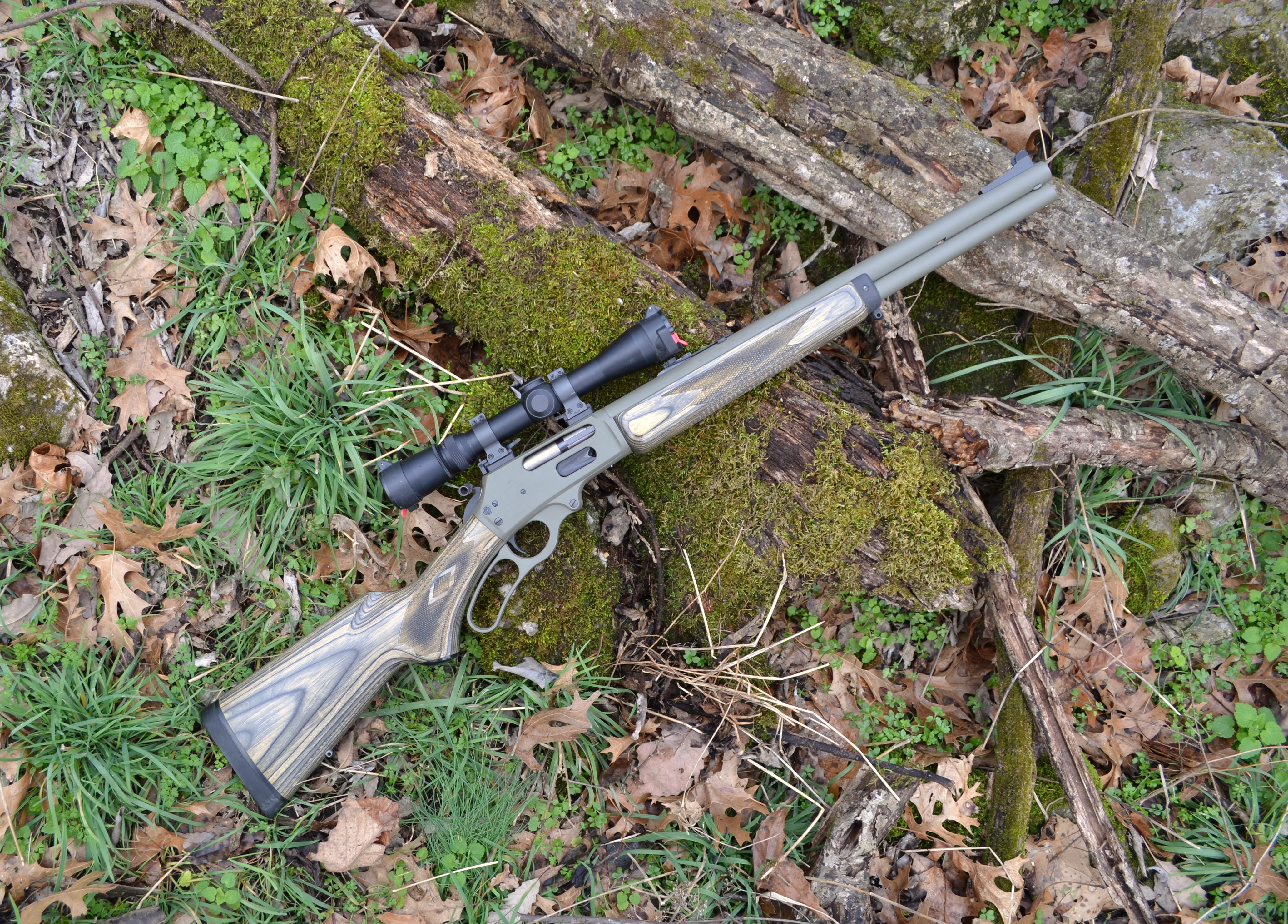
I settled on Brockman sights. The rear sight is a ghost ring built into the scope base. Talley Rings fit the base like they grew there. The front sight is the Brockman armored sight.
This sight features an elevation adjustable post between two very sturdy ears. I ordered two sets of Talley quick detachable rings to hold the 2X Leupold for the general purpose load and the 1.75 x 6 Vari X-III for the shots out to 400 yards. My biggest concern was repeatability after detaching and reattaching the scopes. A quick trip to the range proved that this was a non issue. I could switch back and forth between scopes and no matter what I did the groups never exceeded 2” with mixed sight options. The beauty of the two scopes is I can sight both in for one load for redundancy or sight one in with the general purpose or dangerous game loads and the other for long range shots. With two scopes and the peep sights the possibilities are endless.

The only problem I could think of was taking the extra scope out in the field. Simply Rugged built me a scope pouch that is padded and closes with a zipper. It easily fits in my pack. In addition to holding the scope, a trajectory chart stays in the pouch just in case I forget how the scope is sighted.
Adding Firepower.
With the sighting issues worked out the next item on the agenda was firepower. After a conversation with my Alaskan guide friend that had shot it out with big bears I wanted all I could get from the little rifle. A call to Jim Brockman solved that issue. He had already made a couple of extended magazine tubes for the 450 Marlin. The gun was sent his way for the work along with an action job and a bear proof ejector. He cut a dovetail in the barrel to support the end of the new magazine tube. The new magazine tube allowed the gun to carry a total of 7 shots.
Putting theory to work.
Before all of the work was done to the gun itself I worked up the loads. Part of the ammo testing was done by putting it in the hands of hunters in the field after pressure testing was complete. To get it running I put a Leupold mount on it with a 2X Leupold scope. I used it on a water buffalo that weighed over 2000 lbs. using the 420 grain load. It performed perfectly. It was sent with numerous hunters all over the US and Canada with the 300 grain Nosler Partition load and it gained quite the reputation as a bear killer. During this time One of my friends took the rifle on a bear hunt and ended up being the hunted. He had to stop a charging bear at 6 feet. I don’t really know how many animals that gun has accounted for. I killed my second best whitetail with it. A massive 315 lbs. buck that carried 142” of antler.
Fighting the elements.
I had my sighting systems, firepower and loads worked out. The other fight the rifle was intended for is to be resistant to harsh weather. The best option since Marlin didn’t offer a SS .450 was cerokoat. I carried the gun to WW-guns in Danville, Alabama. I had seen
their work and knew it was top notch. To make the rifle less visible to game I picked a green color that matched well with the laminated stocks. The small parts were coated with flat black making a nice contrast. The internal workings of the gun including inside the magazine tube were given a light coat of Eezox. Not enough to gum things up but enough to make sure all of the metal was protected.
The verdict.
To make a long story short, the perfect rifle is very possible. Since it was built, there have been improvements in powders that can potentially add more power to it but why mess with perfection? It did and has done everything I have asked of it. It has made long range shots on game, fought charging bears, been soaked without incurring damage. While this may not be your idea of the perfect rifle I hope it encourages you to build your own perfect rifle.
Stay safe and happy hunting! -RDY