By: Cody Bruce
Blame Mama for the .44 (and them Texans) In the grand pantheon of esteemed handgun hunters I can confidently say that I take my place somewhere near the bottom, just above those who have liberated themselves of an extraneous toe while practicing their quick draw in front of that bathroom mirror. That is to say, that I am middling shot, too often reach for the rifle, and have the predilection of most middle-aged suburban men where I spend more time ordering gear off of the web and much less time in the actual field.

Despite, this I’ve nonetheless developed exquisite taste. For that, I blame mama. You see, I am the product of an honest-to-goodness Okie cowgirl. When mom wasn’t breaking horses, hauling rocks, splitting wood, chopping ice in ponds, catching catfish, picking pecans, cooking, deer hunting, or giving someone a piece of her mind she often dove into the pages of Louis L’Amour, Zane Grey, and Larry McMurtry. When I was but a pup the two constant songs in her lullaby rotation were Ghost Riders in the Sky and Streets of Laredo. Little wonder then that my country life frequently featured ballads by the one-and-only Marty Robbins. Thus Big Iron and Mr. Shorty weighed heavy on my mind years later when I decided to purchase my first hunting handgun.

The .44 spoke and sent lead and smoke and seventeen inches of flame I thought about these lyrics as I sat in front of a laptop circa 2013, eyes gleaming, as I perused Gunbroker. Like mama, I too had found my own inspiration in pages of descriptive western derring-do. Of course, I owed a debt to the Grand Old Man himself: Elmer Keith. His stories beggared belief and I marveled at the variety and volume of game that he took with the revolver. In retrospect, if I was permitted to take potshots at every red-tailed hawk sitting on a fencepost I encountered I might be a more adequate handgunner myself (but I digress). I also found Skeeter Skelton a more-than-adequate heir to the handgunning legacy of Keith. In fact, my introduction to Skeeter via the writings of Sheriff Jim Wilson set the hook deep on one cartridge in particular: the .44 Smith & Wesson Special. These Texans, Wilson and Skelton, resonated with me in a deep way despite having never met them. By all accounts they seemed to be made of the same stock as the good folks I knew in Oklahoma: honest, hardworking, not prone to exaggerate or mislead, and both literally and figuratively straight shooters. What is more, Skeeter’s writings about his depression era upbringing and childhood antics reminded me of the best aspects of my own country youth. Add to the fact that Keith himself had written that “I consider the .44 Special our finest large bore revolver cartridge by a wide margin” (prior to the advent of the .44 Remington Magnum) then I was satisfied that a 5.5” Ruger New Model Blackhawk with the flat top frame would be sufficient for all the scenarios that I was likely to get entangled with. It goes without saying that suitable leather would also have to be procured and I near simultaneously ordered a Sourdough Pancake holster and a Chesty Puller chest rig for the Blackhawk from Rob Leahy at Simply Rugged as well. A week later I was sitting the basement of a home FFL holder filling out an ATF form 4473 for the single action which I had so long though about. As I recall I paid exactly (removed💵 for fb) for it at the time.

Had I known then what I know now I would have tried to buy a dozen of them. I hunted whitetails with the Blackhawk on and off for several years on Kansas public land without so much as firing a shot. I found that fierce competition for deer meant that I had better be seizing any opportunity that came my way. Thus, more often than not I took a .338 Winchester Magnum rifle afield for whitetails and was quite happy to lob 250 gr Nosler Partitions at any legal deer which happened to traipse within a quarter mile of me. Despite this, as a weapon for rambling I found no peer to the .44 Special. The vast majority of my time spent in the woods was not technically deer-hunting but in doing what I like to call walkabout. I spent innumerable hours foraging for mushrooms. I waded countless lake-bottoms and rivers while bowfishing, scouting for trapping ground, and deciding on duck blind locations. I hiked miles upon miles in search for the perfect treestand locations and I did all of this while wearing the Blackhawk in that chest rig. Back home, the same could be said for most activities on the farm away from the house itself. The Ruger also joined me on camping trips across the United States—including the Ouachitas and Wichitas (if you can differentiate those mountain ranges, you are a true Okie). Though I hadn’t taken a whitetail with the .44 I had grown more adept with it and had begun to tally quite a few small game harvests and had made some key coup de grâce shots with it on deer. Thus, I arrived at both my best and worst shots on game with a handgun. The highlight of my not-so-storied handgunning career transpired on a cold, overcast January day in northeastern Kansas. I had decided that such a day would be good for still hunting as a recent rain had dampened the leaf litter and I knew of a great oak grove on a local public hunting area. I had on many occasions ‘slipped’ through this grove and had taken a fair amount of game by ambush. To confess, I will never place at Camp Perry and Boone & Crockett does not know me on a first name basis. However, I do take deep pride in my own woodsmanship and this style of hunting I find most rewarding. To get close enough on foot to place an arrow or handgun bullet into the vitals is a thrill that I have rarely matched. On this particular day I parked a half-mile short of the entrance and made my way in via the public roadway. To my right was a deep bottom where the lake back-filled after heavy rains and to my left was a dense hardwood forest which quickly transitioned to a redcedar screen before opening up into a hay meadow. The hay meadow then gave way to a 600 acre corn field directly adjacent to the lake. I made my way about fifty yards down the footpath into the hunting area before dipping into the hardwoods and skirting the field edge through the cedars. I forced myself to stop frequently and remembered the old still hunting adage of “listen and look more than you move.” I forced myself to count at least two minutes after every couple of steps and tried to pick out any tail, fur, feather, or beak that happened to be misplaced in the jumble of lobed oak leaves, waving prairie grasses, and cedar boughs within my vantage point. I made my way deeper into the hardwoods and passed by a former home place, long-since abandoned, which strew the woods with random artifacts of humanity. Deeper still I found myself in the massive oaks and paused for some time, scrutinizing both the forest floor and towering treetops. There! At last! Three plump fox squirrels corkscrewed up the bark of a white oak and chattered their delight in their merry chase. I took brief step and braced my extended arms across a convenient branch and cocked the Blackhawk’s hammer. Then I placed the front blade just a shade over the top of the fox squirrel’s shoulder when it paused and the report of the .44 surprised even me. More surprising still was the ‘whap!’ of the 250 gr round nose cast bullet as it struck the squirrel and the following ‘thud!’ as it fell at terminal velocity to bury itself within the detritus of the forest. In disbelief I walked the 40+ yards to the squirrel and picked it up.

Not only was it the best shot I had made with a handgun but it was the largest fox squirrel I had ever seen by a considerable margin. You would be forgiven to think that I exaggerate when I describe the proportions of this squirrel, but trust that my ample consumption of fried squirrel & gravy, Brunswick stew, and smoked squirrel is sufficient experience for me to judge. It was bigger than your average house cat! Of course, not all tales can have such happy endings. A few years later I found myself in the ‘old faithful’ of my whitetail stands: the ‘sanctuary stand’. This is a two person ladder stand in an aged pecan tree located in an island of timber which is encircled by a strip of native prairie about 75 yards wide which is itself enclosed in another ring of timber. Throughout the years I had found that large whitetail bucks when pressured often made their way to this oasis of relative seclusion. There waiting for them I had also found considerable successful and had added several quality racks to my trophy room wall. In Oklahoma’s November firearms season the sun sets about 5:20 PM and the period around that time is by far when I have taken the most deer. The problem with this is that the ‘sanctuary stand’ must face west due to property lines and shooting lanes. With a scoped rifle the sun settling down just above the trees is a minor issue but for an iron-sighted handgunner the glare is quite troublesome. On this occasion I had a shooting rail folded down and my Blackhawk rested across it. The extra wide two-man ladder stand also afforded me room to lean my .338 bolt action up beside me in case the shot distance was too far. However, I was convinced to give the first opportunity to the Ruger. It deserved to take a deer after all of these years! As sunlight nearly blinded me just before prime time in the hunt I was able to make out the glint of light off of chocolate antler about sixty yards off in a patch of tall Bluestem grass. What antlers they were! The buck was close enough for me to tell that he was truly magnificent and I was left with little doubt that he would be the biggest I had ever taken. I make a point of not dwelling on antler size in the moment, but as I recount this story there was certainly 140” of antler in his crowning glory. I leaned into the rail somewhat and ensured that my arms were steady as he made his way ten yards closer. I struggled to find the front sight in the glare of the sun but managed it finally and placed the blade squarely over his lungs before squeezing the trigger. At the report of the .44 the buck bolted without demonstrating the mule kick that often accompanies the fatal lung shot. Worse yet, I distinctly observed an overhanging pecan limb about 15 ft in front of me fall to the ground, cleanly severed by a 255 gr. Keith bullet. I was apoplectic. Frothing. I yearned to heave the Ruger, discus-style, as far into the woods as I possibly could. Why hadn’t I just used the .338? It would have been a chip shot and that beautiful typical buck would have been served with Cumberland sauce and wild rice and there would be an impressive European mount to point to as I regaled my friends with tales of my own hunting prowess. Alas, it was not to be. I examined the fallen pecan branch and performed grid searches for hair or blood within expanding circles of where the buck had been standing with no luck. Frustrated, I headed back to the truck with the Blackhawk holstered and the .338 slung over my shoulder. As I approached 100 yards from the truck I came upon a finger of timber jutting out into the field and noted a doe and yearling on the opposite side. The doe fled immediately but the yearling tarried a bit too long and I whipped the .338 from my shoulder, sending a Partition down range. The tender meat and easy drag to the truck were much appreciated, giving me some consolation for the prior incident that had occurred within the same hour. Of late I have been drawn deeper into the world of handgun hunting, practicing more and investing in more specialized platforms. A 14” CVA Scout in .300 Blackout with a 3-12x Burris scope, a 7.5” Magnum Research BFR in .44 Magnum, and now a Glock 41 customized to shoot .45 Super have joined the armory with the old Blackhawk. But, one does not forget his first love. When the wind blows cold and the woodsmoke curls from the chimney and the wanderlust churns something in my blood it is that .44 that I reach for first when my heart is bidden to roam. It continues to accompany me on my jaunts, camping trips, and more recently when I am joining my friends and family in pursuit of wild boar with hounds. I have found that the .44 Special Blackhawk in the Simply Rugged Chesty Puller rig and a Cold Steel OSI knife on the belt is as good a rig as can be had for sticking pigs and busting through the greenbriers of the Oklahoma crosstimbers. Each time I wear it I think of mama, of Marty Robbins, Elmer Keith, Skeeter Skelton, and Jim Wilson! Truth is, I like Texas and Texans! We may not have gotten along extremely well since Oklahoma Governor ‘Alfalfa Bill’ Murray called out the Oklahoma National Guard in the ‘Red River Bridge War’ with the Texas Rangers but they grow on me each day. After a 2024 hunting trip in Cleburne, TX for pigs I have determined that the only difference between Okies and Texans is that our BBQ is better, our horses are faster, and our dogs are grittier.

Shooting and Loading Notes:

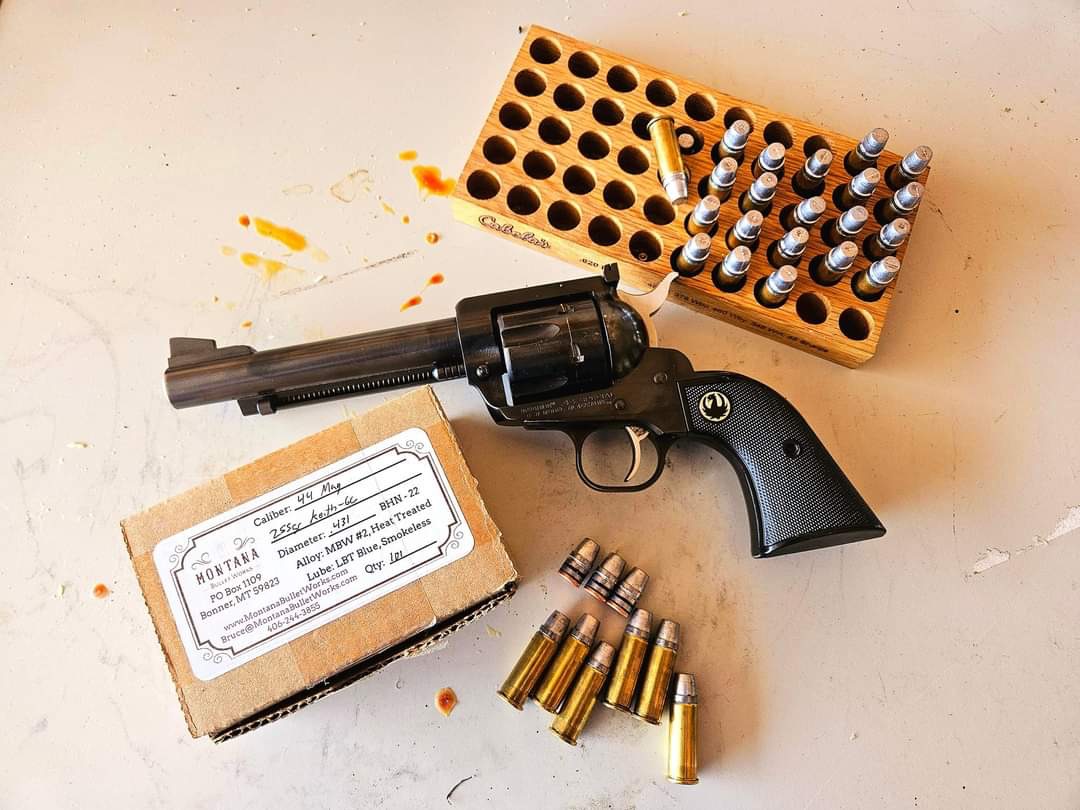
My experience with the .44 Special mirrors that which is documented throughout quality sources like Handgunner magazine, Sixgunner, Handloading magazine, and the various loading manuals available today. I have found little reason to deviate from Skeeter Skelton’s loading which he describes as “…a powder charge of 7.5 grains of Unique, and using both the Lyman-Keith 429421 250-grain cast bullet and the jacketed Speer 235-grain HP” (Converting .357s to .44 Specials, Shooting Times Magazine, April 1972). I continue to use this powder charge for 240 – 250 gr cast, preferring the true Keith shape when available. I have not found a need for a gas check in the .44 Special but I do opt for one when loading the same style of bullets in the .44 Magnum in both pistol and rifle. In post-harvest examinations I have found that the wound channel from semi-wadcutter (SWC) or wide-flat nose (WFN) hard cast out of the .44 Special is typically narrow but that the penetration is very sufficient. These examinations are exclusive to shots from relatively close range (<50 y) with the Blackhawk with the impact velocity between 800-925 FPS. These loads are safe in my Blackhawk and are not recommended without your own research and consulting established loading manuals. Additionally, I would not recommend Skeeter’s loads (much less Keith’s—the horror) in any weaker arms such as the Charter Arms Bulldog. Quality ammunition for the .44 Special of truly sufficient power for hunting whitetails or boar is available from Buffalo Bore, Underwood, Double Tap, and Grizzly Cartridge Company. I feel that hardcast in the .44 Special is best paired with shoulder shots impacting bone which reduces the animal’s mobility and leverages the highly penetrating nature of the non-deforming semi-wadcutters and wide flat nose designs. Much of the factory cast ammo is as Keith describes “little more than a squib” (Sixgun Cartridges and Loads) and suitable only for plinking and small game hunting. This is particularly true for the commonly available cowboy action loads. Although cast is typically what I load for dedicated hunting ammo I would also be remiss in failing to mention the 180 gr. Hornady XTP projectile as well. Hornady has for a number of years ran the ‘Get Loaded’ promotion which allows consumers to provide proof-of-purchase for metallic die sets in exchange for free bullets. I have extensively utilized this promotion and have found that the 180 gr. .430” XTP which is eligible for the promotion is an extremely accurate bullet in the Blackhawk using the 7.5 gr Unique powder charge. Given the increased velocity with this light bullet (900 FPS in 3”, likely 1,000 FPS in most hunting-length barrels) this would be a good candidate for personal protection and heart/lung shots on medium game. The retail price of the XTP in addition to the ‘Get Loaded’ promotion means that you can have a single load for range and light field use. My preference is Starline brass for the .44 Special and I have found very good durability over repeat loadings. I utilize normal straight-wall handgun cartridge loading practices and dies with the exception of employing the Lee Factory Crimp die which I feel provides better ignition and reduces bullet setback in straightwall cartridges.

Cody Bruce is a proud Okie with an abiding love for the land and wild things. He is solidly mediocre in all manner of hunting, Tenkara flyfishing, mushroom foraging, fur-trapping, decoy carving, and poetry. His enjoyment of handgun hunting is derived from the intrinsic challenge of the pursuit, the woodsmanship required to close the distance on wary game animals, and the historical and cultural significance of handguns within American society.
Be sure to check out the Handgun Hunting Afield Forum! Your place to discuss all things handgun hunting!
4 responses to “Blame Mama for the .44”
Nice job.
Wonderful story’s, I felt like I was in the woods with you.
Love the story’s. I felt like I was in the woods walking with you.
Great story!